Saab JAS 39 Gripen Multirole Combat Aircraft
Introduction
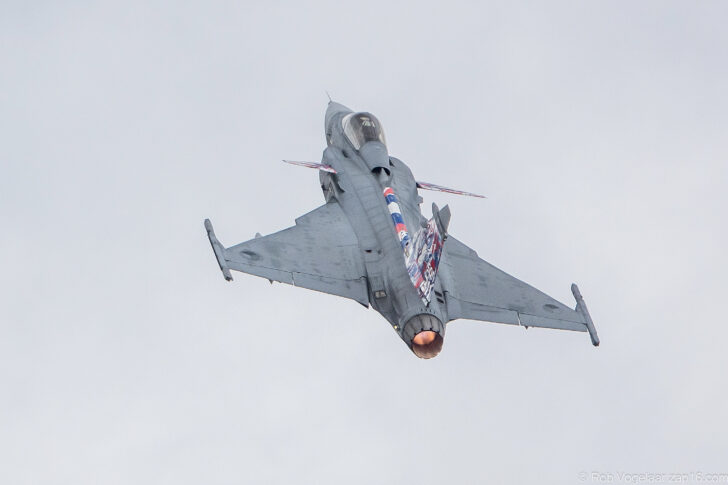
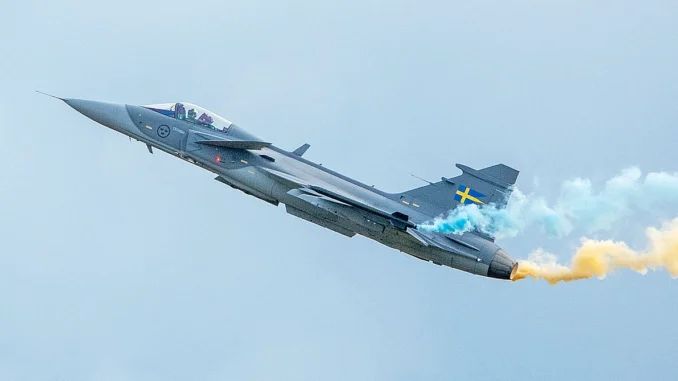
The Saab JAS 39 Gripen is a light, single-engine multirole fighter aircraft designed and manufactured by the Swedish aerospace company Saab. Built to replace the Saab 35 Draken and Saab 37 Viggen, it combines a canard-delta wing configuration with advanced digital fly-by-wire flight controls. Engineered for dispersed operations, low operating costs, and high operational availability, the aircraft serves multiple air forces worldwide.
General Information
-
Type: Multirole combat aircraft (JAS: Jakt / Air-to-Air, Attack / Air-to-Ground, Spaning / Reconnaissance)
-
Manufacturer: Saab Aeronautics
-
First Flight: 9 December 1988
-
Status: In service and in production
-
Primary Users: Swedish Air Force, Brazilian Air Force, Czech Air Force, Hungarian Air Force, Royal Thai Air Force, South African Air Force
-
Number Built: Approximately 300+ units across all variants
History
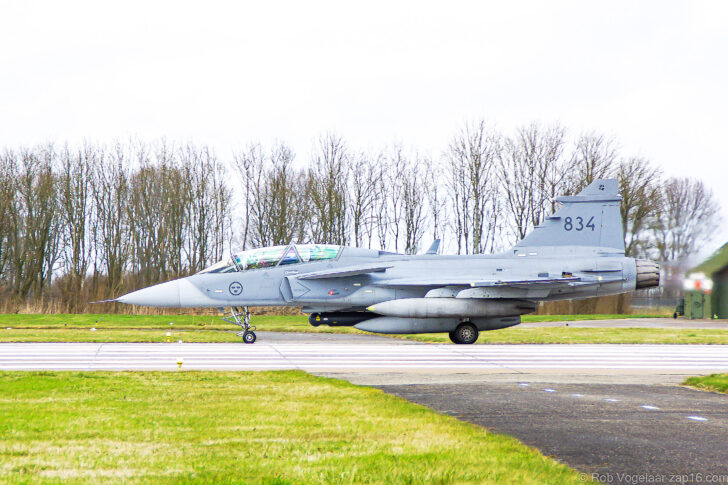
Development of the JAS 39 Gripen originated in the late 1970s, when the Swedish Defence Materiel Administration (FMV) sought a versatile multirole fighter to defend Sweden’s airspace during the Cold War. In 1982, the Swedish government awarded a development contract to Industrigruppen JAS, a consortium formed by Saab, Volvo Flygmotor, Ericsson, and FFV.
The design brief mandated an aircraft capable of operating from public highways and short, austere runways, requiring a minimal ground crew for turnaround. The prototype completed its maiden flight on 9 December 1988, and the type entered operational service with the Swedish Air Force in 1996. Over the decades, the platform evolved into export models and the modernized Gripen E/F series.
Design
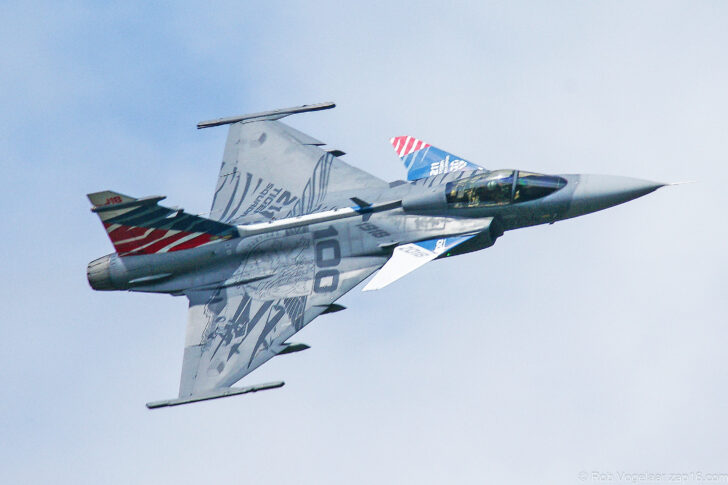
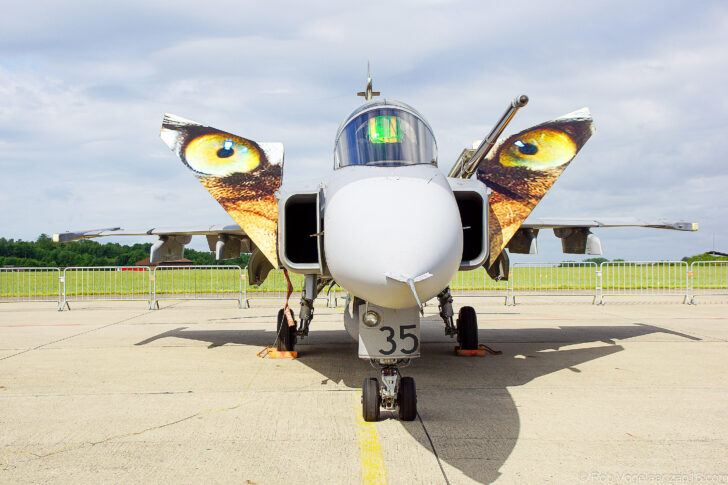
The JAS 39 Gripen utilizes an unstable aerodynamic design with close-coupled canards and a delta wing, stabilized by a triplex digital fly-by-wire system. The airframe incorporates composite materials to reduce weight and radar signature. Powered by a single Volvo RM12 (a derivative of the General Electric F404) or a General Electric F414-GE-39E turbofan on the Gripen E, the jet delivers high maneuverability across its speed envelope.
The cockpit layout features wide-angle Head-Up Displays (HUD), multi-function color screens, and Hands On Throttle-And-Stick (HOTAS) controls. Advanced avionics suites—including the PS-05/A pulse-Doppler radar or Raven ES-05 AESA radar—enable dynamic sensor fusion, electronic warfare defense, and multi-target engagement capabilities.
Operational Impact
The JAS 39 Gripen demonstrated the feasibility of maintaining high sortie rates using small maintenance crews and short road strips (600 meters). The design emphasizes rapid turnaround times, enabling air-to-air refueling and re-arming in ten minutes by ground crews. Operating costs remain significantly lower than traditional heavy twin-engine fighters. The type participated in international coalition tasks, including NATO-led reconnaissance missions during Operation Unified Protector over Libya in 2011, establishing a reputation for high mission readiness and interoperability.
Variants
-
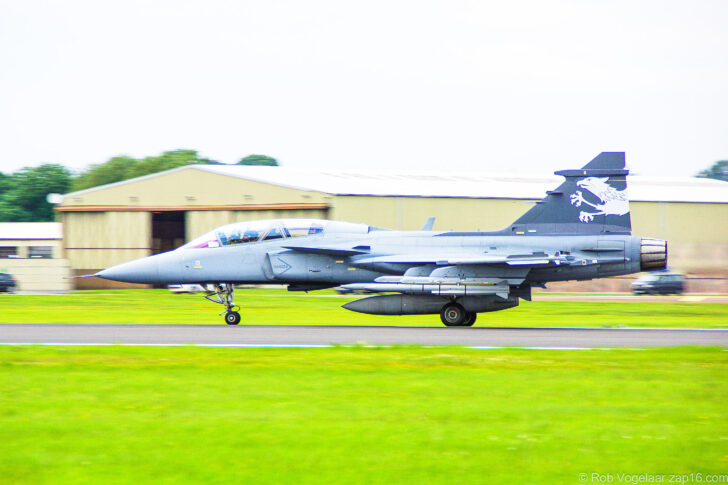
JAS 39A: Initial single-seat production variant for the Swedish Air Force.
-
JAS 39B: Two-seat conversion trainer variant based on the A-model, lacking an internal gun.
-
JAS 39C: Standard NATO-interoperable single-seat model featuring in-flight refueling capabilities, updated avionics, and expanded weapons integration.
-
JAS 39D: Two-seat operational trainer and command variant based on the C-model.
-
JAS 39E: Next-generation single-seat variant (Gripen E) featuring an upgraded AESA radar, higher payload capacity, increased internal fuel storage, and a GE F414G engine.
-
JAS 39F: Two-seat next-generation variant (Gripen F) developed primarily for training and mission control tasks.
Operators
-
Current: Sweden, Brazil, Czech Republic, Hungary, Thailand, South Africa, United Kingdom (Empire Test Pilots’ School)
-
Former: None
-
Future: Colombia, Peru, Ukraine
Specifications (JAS 39C / Gripen C)
General Characteristics
-
Crew: 1 (2 for two-seat variants)
-
Length: 14.1 meters
-
Wingspan: 8.4 meters (including wingtip launchers)
-
Height: 4.5 meters
-
Wing Area: 30 square meters
-
Empty Weight: 6,800 kilograms
-
Maximum Takeoff Weight: 14,000 kilograms
-
Powerplant: 1 × Volvo RM12 afterburning turbofan
-
Dry Thrust: 54 kilonewtons
-
Thrust with Afterburner: 80.5 kilonewtons
-
Performance
-
Maximum Speed: Mach 2.0 (2,100 kilometers per hour) at high altitude
-
Combat Radius: 800 kilometers
-
Ferry Range: 3,200 kilometers
-
Service Ceiling: 15,240 meters
-
G-Limits: +9 / -3 g
Armament
-
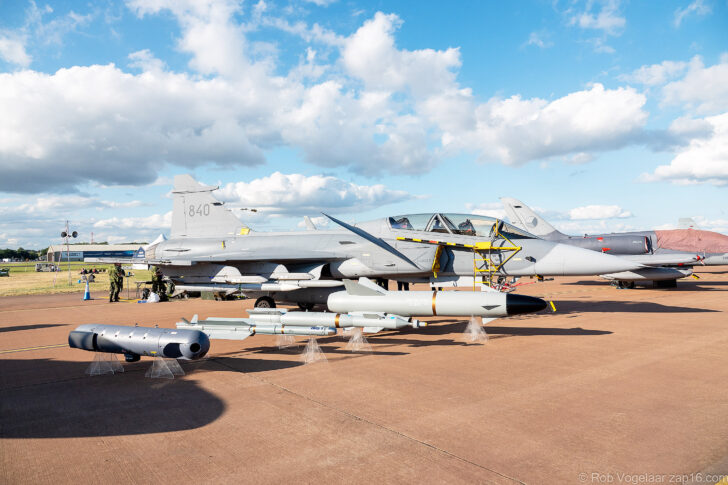
Guns: 1 × 27 mm Mauser BK-27 revolver cannon with 120 rounds (single-seat variants only)
-
Hardpoints: 8 stations with a total payload capacity of 5,300 kilograms
-
Missiles:
-
Air-to-Air: AIM-9 Sidewinder, IRIS-T, AIM-120 AMRAAM, MBDA Meteor, MICA
-
Air-to-Surface: AGM-65 Maverick, KEPD 350 Taurus, RBS-15F anti-ship missile
-
-
Bombs: GBU-12 Paveway II, Mk 82, GBU-39 Small Diameter Bomb
The Saab JAS 39 Gripen remains a cornerstone of Swedish defense strategy and a successful export aircraft in the lightweight fighter category. Its combination of operational flexibility, low maintenance overhead, and continuous software modernization ensures long-term viability. As next-generation Gripen E/F deliveries expand globally, the platform will continue to play a pivotal role in modern air defense networks.