Introduction
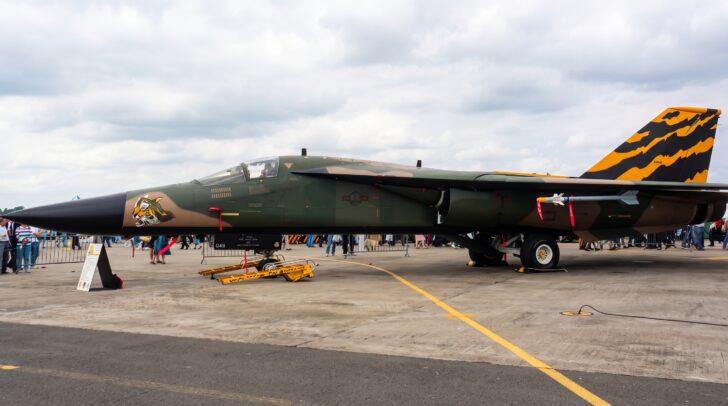
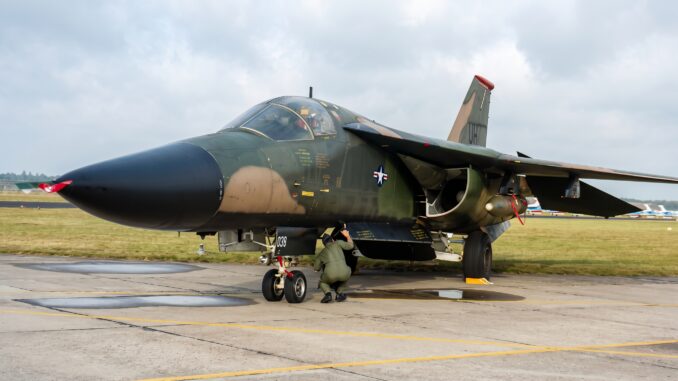
The General Dynamics F-111 Aardvark stands as a landmark achievement in modern military aviation, pioneering production variable-sweep wing technology, afterburning turbofan engines, and automated low-level terrain-following radar. Designed as a supersonic, all-weather tactical strike aircraft and strategic bomber, it set enduring benchmarks for precision interdiction, deep-penetration bombing, and long-range electronic warfare throughout the Cold War.
General Information
- Type: All-weather multirole strike aircraft, tactical fighter-bomber, and strategic bomber
- Manufacturer: General Dynamics
- First Flight: December 21, 1964
- Status: Retired
- Primary Users: United States Air Force (USAF), Royal Australian Air Force (RAAF)
- Number Built: 563
History
The genesis of the F-111 traces back to the 1961 Tactical Fighter Experimental (TFX) program initiated by United States Secretary of Defense Robert McNamara. The Department of Defense sought a unified multirole platform to satisfy both the Air Force requirement for a deep-penetration strike aircraft and the Navy requirement for a carrier-based fleet air defense interceptor.
In November 1962, the Pentagon selected General Dynamics in partnership with Grumman to build the aircraft. While the carrier-based naval variant, designated the F-111B, suffered from excessive weight and saw cancellation in 1968, the land-based Air Force version matured into an effective strike platform. The aircraft entered USAF service in 1967, overcame initial structural and fatigue challenges during early combat trials, and established a record of frontline service spanning four decades.
Design
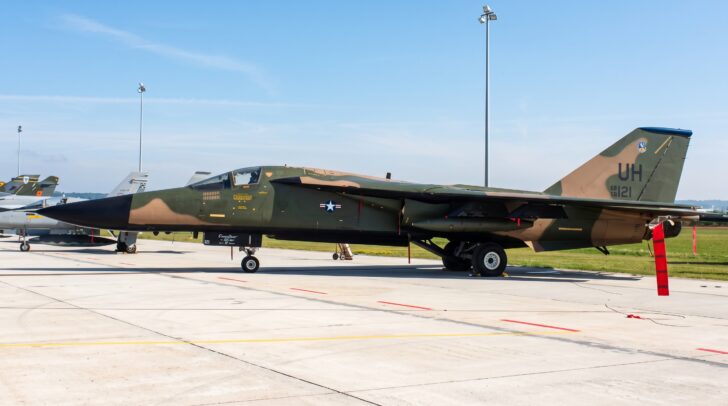
The airframe introduced several revolutionary technologies to production combat aircraft:
- Variable-Geometry Wings: Wing sweep mechanically shifted between 16 degrees (spread for takeoff, landing, and cruising efficiency) and 72.5 degrees (fully swept for high-speed supersonic dash).
- Automated Terrain-Following Radar: The forward avionics suite linked an autopilot system with terrain-following radar, enabling automated, hands-off penetration at altitudes as low as 60 meters in total darkness and adverse weather.
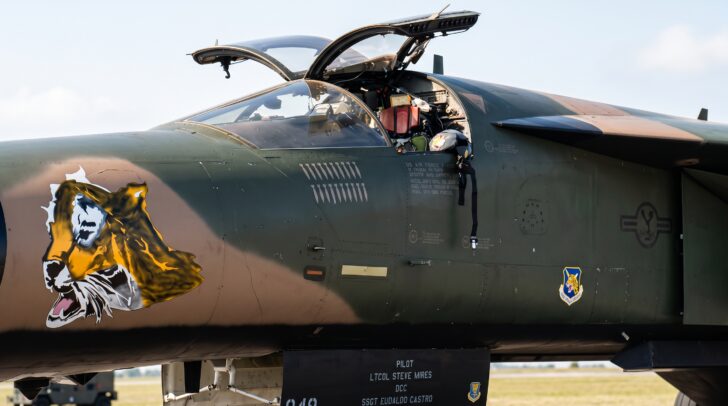
- Crew Escape Module: Instead of individual ejection seats, the cockpit featured an integrated, jettisonable crew capsule that insulated the two-person crew (seated side-by-side) from harsh supersonic slipstreams and deployed a dedicated parachute and airbag landing system.
- Internal Weapons Bay: The fuselage incorporated a dedicated bay for auxiliary fuel tanks, tactical munitions, or an optional rotary cannon to reduce aerodynamic drag during high-speed transit.
Operational Impact
The F-111 transformed tactical strike doctrine by mastering low-level penetration below hostile radar coverage. During the later phases of the Vietnam War, notably Operation Linebacker II in 1972, F-111 strikes operated independently without fighter escort or aerial jamming support.
In April 1986, USAF F-111F bombers executed Operation El Dorado Canyon, completing a long-range nonstop strike against targets in Libya from bases in the United Kingdom. During the 1991 Gulf War, F-111F aircraft delivered precision-guided munitions with unmatched efficiency, destroying over 1,500 armored vehicles during specialized night attacks known as “tank plinking.” In Australia, the RAAF deployed the platform for 37 years as its premier long-range maritime and regional deterrent.
Variants
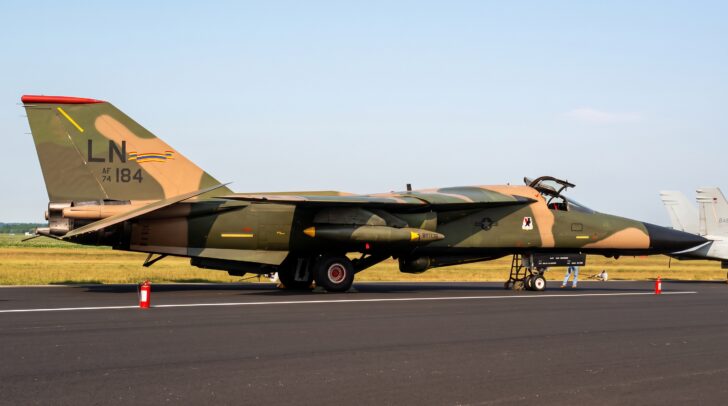
- F-111A: Initial USAF production strike variant powered by Pratt & Whitney TF30-P-3 engines.
- F-111B: Proposed carrier-based fleet air defense variant for the US Navy; canceled before production.
- F-111C: Export strike variant custom-built for the Royal Australian Air Force, featuring extended wings and upgraded avionics.
- F-111D: Advanced strike model fitted with digital microprocessors, Triple Plow II intakes, and an early glass cockpit.
- F-111E: Simplified tactical variant bridging the transition between the A and D variants.
- F-111F: Final and most capable USAF strike version, equipped with higher-thrust TF30-P-100 engines and Pave Tack targeting pods.
- FB-111A: Strategic bomber conversion for Strategic Air Command, built with enlarged wings and nuclear strike capability (later modified as conventional F-111G trainers).
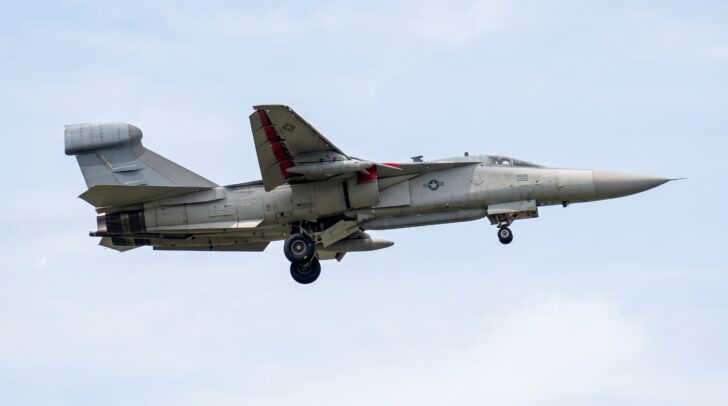
- EF-111A Raven: Dedicated electronic warfare variant converted by Grumman to provide tactical standoff and escort radar jamming.
Operators
- Current Operators: None
- Former Operators:
- United States: United States Air Force (USAF)
- Australia: Royal Australian Air Force (RAAF)
- Future Operators: None
Specifications (F-111F)
General Characteristics
- Crew: 2 (pilot and weapon systems officer)
- Length: 22.40 m
- Wingspan (Spread, 16°): 19.20 m
- Wingspan (Swept, 72.5°): 9.74 m
- Height: 5.22 m
- Wing Area (Spread): 61.07 m²
- Wing Area (Swept): 48.77 m²
- Empty Weight: 21,400 kg
- Gross Weight: 37,600 kg
- Maximum Takeoff Weight: 45,359 kg
- Powerplant: 2 × Pratt & Whitney TF30-P-100 afterburning turbofans
- Dry Thrust: 64.1 kN each
- Thrust with Afterburner: 111.7 kN each
Performance
- Maximum Speed (High Altitude): 2,655 km/h (Mach 2.5)
- Maximum Speed (Sea Level): 1,470 km/h (Mach 1.2)
- Combat Range: 2,140 km
- Ferry Range: 5,940 km (with external drop tanks)
- Service Ceiling: 20,100 m
- Rate of Climb: 131.5 m/s
Armament
- Guns: 1 × 20 mm M61A1 Vulcan 6-barrel rotary cannon mounted in internal weapons bay (optional/rarely fitted)
- Hardpoints: 8 underwing pylons (4 pivoting, 4 fixed) plus 1 internal weapons bay, carrying up to 14,300 kg of stores
- Ordnance: Conventional unguided bombs, Paveway laser-guided bombs, GBU-15 guided glide bombs, AGM-88 HARM anti-radiation missiles, AGM-84 Harpoon anti-ship missiles (RAAF), and B61/B43 nuclear ordnance
The F-111 Aardvark established a decisive precedent in modern aeronautics by validating swing-wing aerodynamics, high-efficiency turbofan propulsion, and terrain-following avionics under demanding combat conditions. Its operational legacy directly informed the development of later deep-strike platforms such as the Panavia Tornado, Rockwell B-1B Lancer, and McDonnell Douglas F-15E Strike Eagle. Today, surviving airframes occupy prominent positions in global aerospace museums as enduring monuments to Cold War engineering and precision strike doctrine.