Introduction
Britain’s High-Speed Cold War Strike and Reconnaissance Pioneer
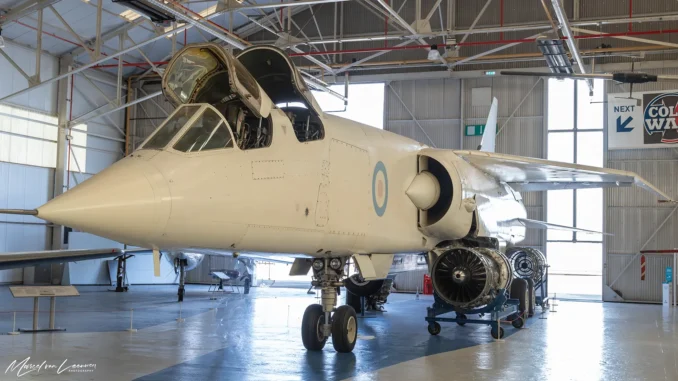
The BAC TSR-2 was an ambitious British supersonic strike aircraft and reconnaissance platform developed during the Cold War. Engineered to penetrate heavily defended airspace at high speed and extremely low altitude, the aircraft incorporated cutting-edge avionics, advanced terrain-following radar, and short takeoff capabilities before its controversial cancellation in 1965.
General Information
- Type: Tactical strike and reconnaissance aircraft
- Manufacturer: British Aircraft Corporation (BAC)
- First Flight: 27 September 1964
- Status: Cancelled
- Primary Users: Royal Air Force (intended)
- Number Built: 3 complete prototypes (1 flown; several additional airframes in assembly)
History
In the late 1950s, the British Air Ministry issued General Operational Requirement 339 (GOR.339) to replace the English Electric Canberra light bomber. The specification demanded an all-weather combat jet capable of tactical nuclear delivery, tactical reconnaissance, and supersonic dashes from rough, semi-prepared runways.
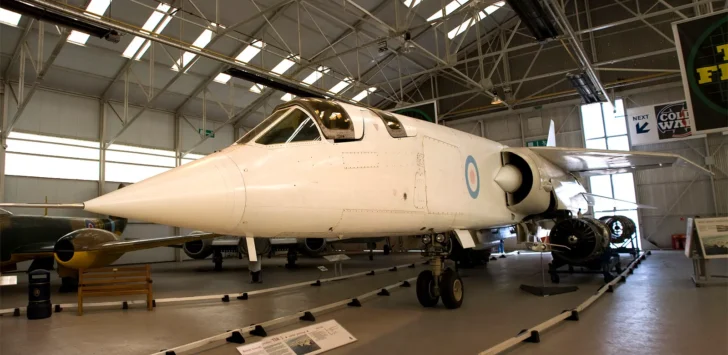
In January 1959, the government selected joint proposals from Vickers-Armstrongs and English Electric, compelling their merger into the British Aircraft Corporation (BAC) in 1960. Test pilot Roland Beamont flew the sole operational prototype, serial XR219, on its maiden flight from Boscombe Down on 27 September 1964. Escalating development budgets, inter-service rivalry, and political friction led the Labour government to cancel the program on 6 April 1965 in favor of the planned procurement of the American General Dynamics F-111K, with existing tooling and prototypes ordered scrapped.
Design
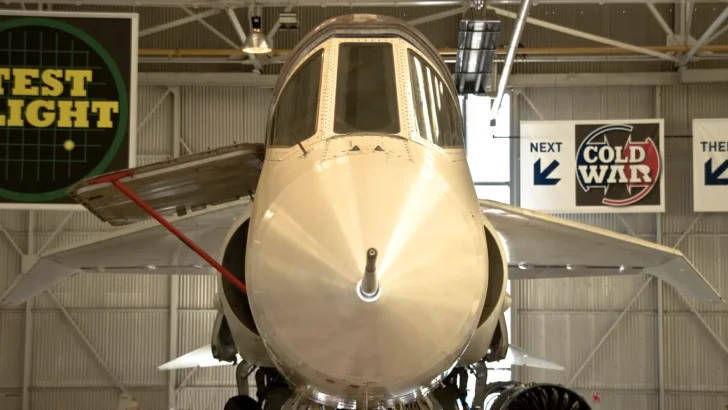
The BAC TSR-2 featured a long, slender fuselage engineered around the transonic area rule to optimize high-speed performance. Its high-mounted, small-area delta wing had pronounced turned-down tips to enhance directional stability during high-speed low-altitude flight. Blown full-span flaps provided high-lift boundary layer control, ensuring short takeoff and landing performance on austere strips.
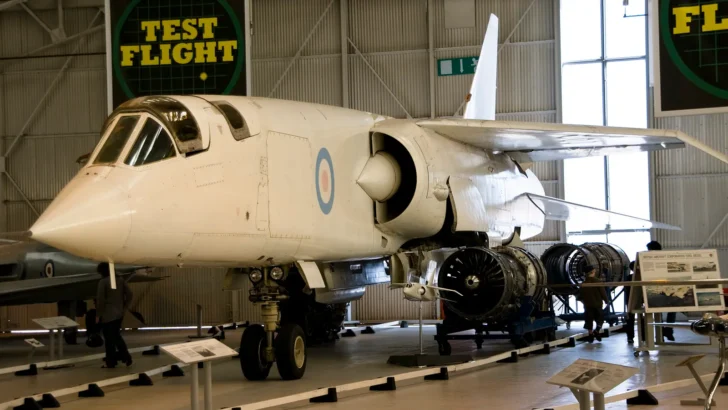
Twin Bristol Siddeley Olympus 320 afterburning turbojets powered the airframe, fed by variable-geometry semi-circular side intakes. The aircraft pioneered integrated avionics, featuring a forward-looking terrain-following radar, side-looking airborne radar (SLAR), an inertial navigation system, and an early head-up display (HUD) that allowed fully automated low-level blind navigation and precision strikes.
Operational Impact
Although the BAC TSR-2 never entered operational service, its advanced aerodynamic and technical concepts exerted a lasting influence on European combat aviation. The cancellation marked the end of independent, large-scale British military strike jet programs and forced the British aerospace industry toward multinational consortia. Technological innovations cultivated during the program directly fed into collaborative European developments, including the Panavia Tornado and the SEPECAT Jaguar, while its powerplant served as the technological baseline for the Olympus 593 engines powering the supersonic Concorde.
Variants
- TSR-2 Prototype (Pre-Production Batch): Flight-test and development airframes (designated XR219 to XR227); XR219 was the only airframe to fly, while XR220 and XR222 were completed for ground trials and preservation.
- TSR-2 Production (Planned): Proposed operational variant for the Royal Air Force, scheduled for delivery in the late 1960s with full combat equipment and avionics suites.
- TSR-2 Variable Geometry (Concept): Early design study evaluating swing-wing configurations for enhanced range and loiter capabilities.
Operators
Current
- None
Former
- None (tested only by the Royal Air Force / Aeroplane and Armament Experimental Establishment during manufacturer and state trials)
Future
- None
Specifications
General Characteristics
- Crew: 2 (pilot and navigator/radar operator)
- Length: 27.13 m
- Wingspan: 11.28 m
- Height: 7.32 m
- Wing Area: 65.03 m²
- Empty Weight: 24,834 kg
- Gross Takeoff Weight: 36,100 kg
- Maximum Takeoff Weight: 46,950 kg
- Powerplant: 2 × Bristol Siddeley Olympus 320 afterburning turbojet engines, 87.2 kN dry thrust each, 136.2 kN with afterburner
Performance
- Maximum Speed: 2,390 km/h (Mach 2.15) at 12,000 m; 1,345 km/h (Mach 1.1) at sea level
- Combat Radius: 1,390 km
- Ferry Range: 6,840 km
- Service Ceiling: 16,500 m
- Rate of Climb: 250 m/s
Armament
- Internal Bomb Bay: Capacity for up to 2,700 kg of ordnance, designed to house 1 × WE.177 or Red Beard tactical nuclear weapon, or 6 × 450 kg conventional high-explosive bombs
- External Hardpoints: 4 underwing pylons with a combined capacity of up to 1,800 kg for unguided rocket pods, fuel tanks, or conventional ordnance
The BAC TSR-2 remains one of British aviation history’s most celebrated technological achievements and tragic program casualties. Its advanced fly-by-wire concepts, automated terrain following, and low-level supersonic performance placed it years ahead of contemporary combat aircraft. Today, the two surviving complete airframes, displayed at the RAF Museum Midlands and the Imperial War Museum Duxford, preserve the enduring legacy of Britain’s Cold War aerospace innovation.