Complete Supersonic Airliner Fact Sheet and Specifications
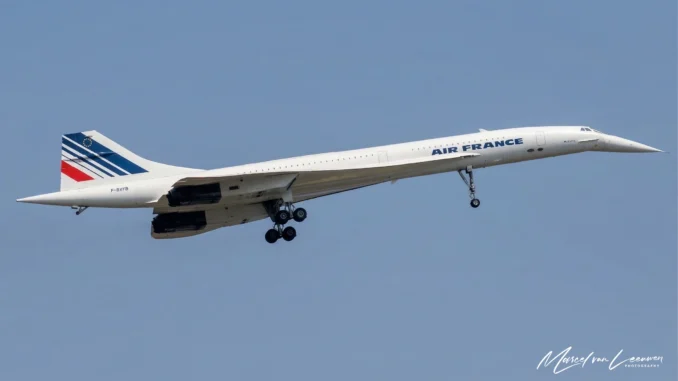
The Aérospatiale/BAC Concorde was a pioneering Anglo-French supersonic passenger airliner that transported travelers across the Atlantic at more than twice the speed of sound for nearly three decades.
General Information
- Type: Supersonic transport (SST) passenger airliner
- Manufacturer: Aérospatiale (formerly Sud Aviation) and British Aircraft Corporation (BAC, later British Aerospace)
- First Flight: 2 March 1969
- Status: Retired (final commercial flight on 24 October 2003)
- Primary Users: British Airways, Air France, Singapore Airlines (wet-lease partnership), Braniff International Airways (interchange lease)
- Number Built: 20 (including 2 prototypes, 2 pre-production aircraft, and 16 production units)
History
The Concorde originated in the 1950s when independent committees in the United Kingdom and France began studying the feasibility of a commercial supersonic transport. In the UK, the Supersonic Transport Advisory Committee, chaired by Morien Morgan, collaborated with aerodynamicists Johanna Weber and Dietrich Küchemann at the Royal Aircraft Establishment (RAE) to develop the slender delta wing concept. Simultaneously, French aerospace engineers at Sud Aviation worked on similar supersonic designs.
Recognizing the immense financial and technical scale of the undertaking, the British and French governments signed an international treaty on 29 November 1962 to merge their efforts. The project united British Aircraft Corporation and Sud Aviation (which merged into Aérospatiale in 1970) for airframe construction, alongside Rolls-Royce and SNECMA for propulsion. Sir Archibald Russell led the British design team, while Lucien Servanty headed the French engineering effort.
Development occurred during the height of the Cold War space and aviation race, directly competing against the Soviet Tupolev Tu-144 and canceled American SST proposals. Prototype 001 completed its maiden flight from Toulouse on 2 March 1969, followed by British prototype 002 from Filton on 9 April 1969. Following more than 5,000 hours of rigorous flight testing, the aircraft entered commercial passenger service on 21 January 1976.
Design
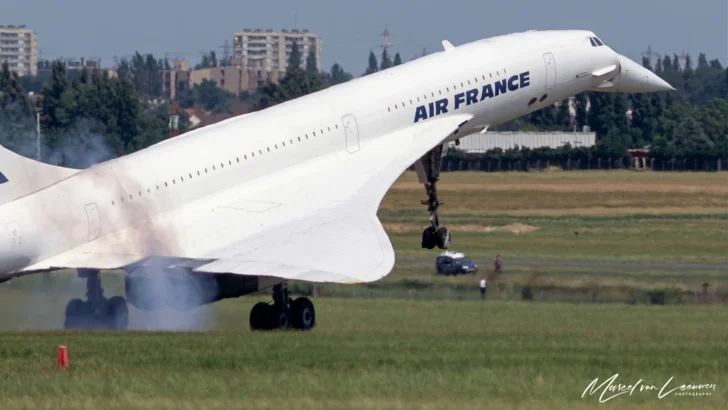
Engineers built the Concorde around a tailless ogival delta wing that generated powerful lift-inducing vortices at high angles of attack during takeoff and landing while minimizing drag at Mach 2. To withstand the intense frictional heating caused by supersonic flight—which expanded the fuselage by up to 30 centimeters—builders constructed the airframe primarily from Hiduminium RR.58 (AU2GN), a specialized high-temperature aluminum alloy.
The aircraft introduced several major aerospace innovations:
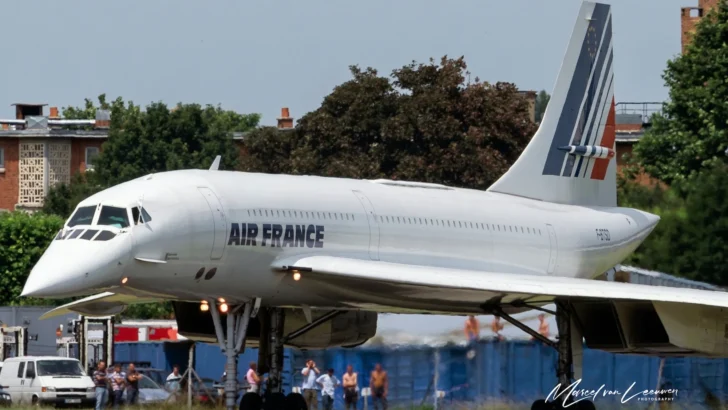
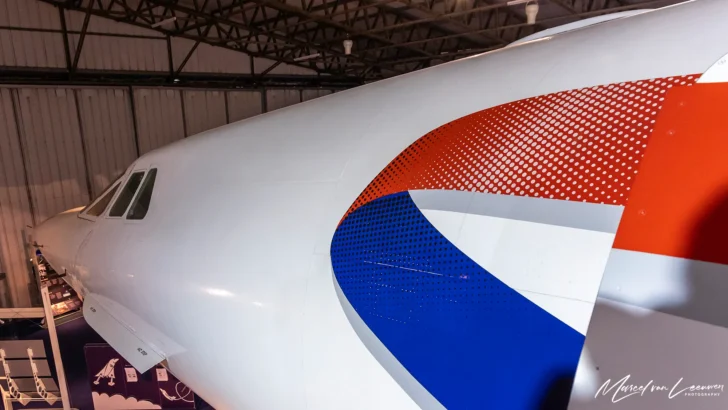
- Droop-Nose Section: A hydraulically actuated nose cone and visor lowered up to 12.5 degrees to give pilots clear runway visibility during low-speed approaches and streamlined the fuselage in flight.
- Variable Engine Intakes: Computer-controlled intake ramps slowed incoming supersonic air to subsonic speeds before it reached the engine compressors.
- Analogue Fly-by-Wire: Concorde was the first commercial airliner equipped with a fully electrically controlled analogue fly-by-wire flight control system and carbon-fiber brakes.
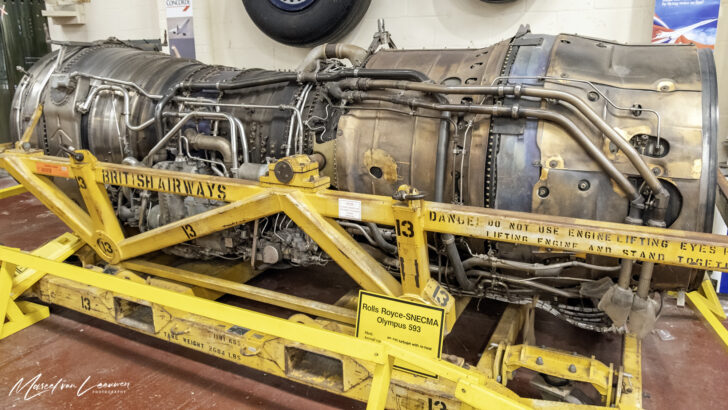
- Supercruise Propulsion: Four Rolls-Royce/SNECMA Olympus 593 afterburning turbojet engines enabled the airliner to sustain supersonic cruise without continuous afterburner engagement.
Operational Impact
The Concorde transformed transatlantic travel by cutting flight times between London or Paris and New York from roughly seven hours to under three and a half hours. Operating at an altitude of 18,300 meters—well above conventional commercial air traffic and weather systems—passengers could observe the curvature of the Earth.
Despite its prestige and safety record over 24 years, operational constraints limited its commercial reach. Sonic booms restricted supersonic flight to overwater routes, preventing major overland expansion. Rising fuel costs following the 1973 oil crisis, the fatal crash of Air France Flight 4590 in July 2000, and the broader aviation downturn after 2001 ultimately led British Airways and Air France to retire their fleets in 2003.
Variants
- Concorde 001 and 002 (Prototypes): Two initial test aircraft assembled in Toulouse (001) and Filton (002) used to validate basic aerodynamics and supersonic handling.
- Concorde 101 and 102 (Pre-Production): Slightly longer aircraft featuring redesigned rear fuselages, extended tail cones, and updated wing leading edges to test production standards.
- Concorde 201 and 202 (Non-Airline Production): The first two production-standard airframes retained by the manufacturers for final certification and endurance trials.
- Concorde 100 Series (Commercial Production): Fourteen definitive production airframes delivered equally to British Airways and Air France for scheduled passenger service.
Operators
- Current: None (all remaining airframes are retired and preserved in museums worldwide)
- Former: British Airways, Air France, Singapore Airlines (joint operation with British Airways), Braniff International Airways (short-term domestic US interchange flights)
- Future: None
Specifications
General Characteristics
- Crew: 3 flight crew (2 pilots, 1 flight engineer) plus 6 cabin crew
- Length: 61.66 m
- Wingspan: 25.60 m
- Height: 12.20 m
- Wing Area: 358.25 m²
- Empty Weight: 78,700 kg
- Maximum Takeoff Weight: 185,065 kg
- Fuel Capacity: 95,680 kg (119,500 liters)
- Powerplant: 4 × Rolls-Royce/SNECMA Olympus 593 Mk 610 afterburning turbojets (169.3 kN thrust each with reheat)
Performance
- Maximum Speed: 2,179 km/h (Mach 2.04 at cruise altitude)
- Cruise Speed: 2,158 km/h (Mach 2.02)
- Range: 7,223 km
- Service Ceiling: 18,300 m
- Rate of Climb: 25.41 m/s
Passengers Layout
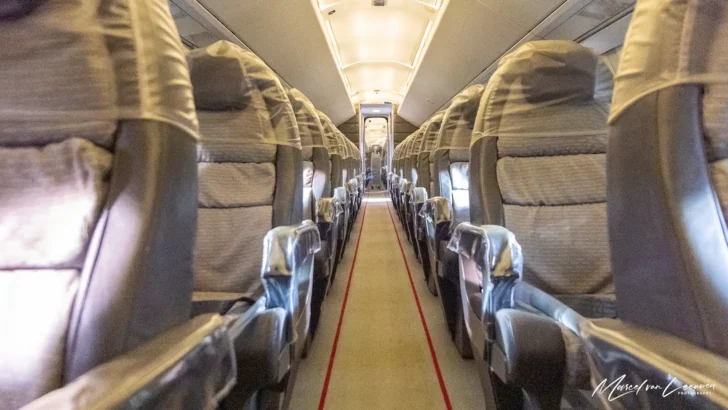
- Seating Capacity: 92 to 128 passengers (typically configured for 100 passengers in a single-class layout)
- Cabin Arrangement: Single-aisle, four-abreast seating (2-2 configuration)
The Aérospatiale/BAC Concorde remains one of the most recognizable milestones in commercial aviation history, proving that sustained supersonic passenger transport was technically viable on a daily schedule. Although high operating expenses and environmental regulations ended its commercial career in 2003, its aerodynamic and propulsion breakthroughs continue to guide modern aerospace programs. Today, next-generation quiet supersonic airliner projects build directly upon the operational lessons learned from Concorde’s decades of service.