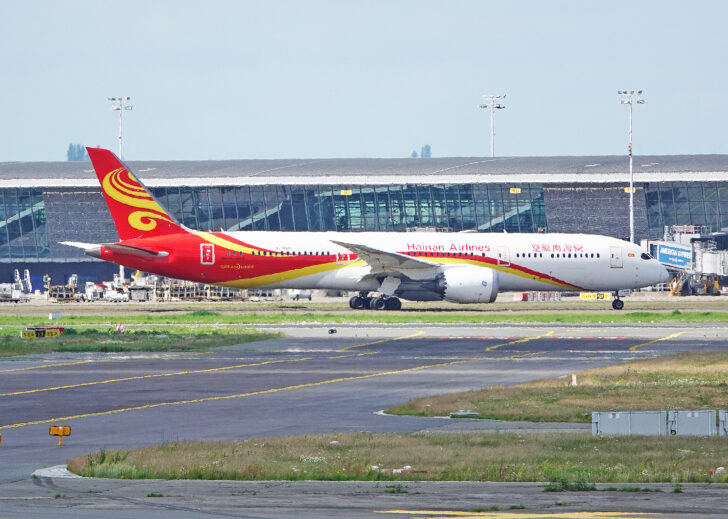
Boeing 787 Dreamliner: Development History, Specifications, and Operators
Introduction
The Boeing 787 Dreamliner is an American long-range, wide-body twin-engine jet airliner designed for high-efficiency point-to-point commercial travel. Featuring a composite-heavy airframe, advanced flight systems, and fuel-efficient turbofan engines, the aircraft allows airlines to economically serve long-distance non-stop routes.
General Information
-
Type: Wide-body twin-engine jet airliner
-
Manufacturer: Boeing Commercial Airplanes
-
First Flight: December 15, 2009
-
Status: In service and in production
-
Primary Users: All Nippon Airways, United Airlines, American Airlines, Japan Airlines, Qatar Airways, Air India, Etihad Airways, British Airways, Qantas
-
Number Built: Over 1,300 (as of 2026)

History
Boeing formally launched the 787 program on April 26, 2004, following an initial order from launch customer All Nippon Airways (ANA). Developed to replace older aircraft like the Boeing 767, the program focused on achieving a 20% reduction in fuel consumption through advanced aerodynamics and lightweight composite materials. Despite early manufacturing challenges and supply chain delays, the prototype completed its maiden flight in December 2009. All Nippon Airways introduced the 787-8 into commercial passenger service on October 26, 2011.
Design
The Boeing 787 Dreamliner airframe consists of approximately 50% composite materials, primarily carbon-fiber-reinforced polymers, alongside aluminum, titanium, and steel. This construction reduces overall structural weight and offers superior resistance to fatigue and corrosion. The aerodynamic profile features high-aspect-ratio wings equipped with raked wingtips to minimize drag during cruise. Engine options include the General Electric GEnx-1B and Rolls-Royce Trent 1000. The flight system utilizes an all-electric architecture, replacing traditional bleed-air systems with electrically driven compressors to improve power efficiency.

Operational Impact
The introduction of the Boeing 787 enabled airlines to bypass traditional hub-and-spoke networks in favor of point-to-point long-haul routes. Lower operating costs per seat-kilometer allowed carriers to open hundreds of new international non-stop pairs. Passengers benefit from lower cabin altitude pressure, increased humidity levels, larger electronically dimmable windows, and reduced interior noise levels compared to previous-generation wide-body aircraft.
Variants
-
787-8: The baseline model, measuring 57 meters in length with a typical two-class capacity of 242 passengers.
-
787-9: A stretched variant measuring 63 meters in length, offering increased range and capacity for up to 290 passengers.
-
787-10: The largest variant at 68 meters in length, accommodating up to 330 passengers in a typical multi-class configuration.

Operators
-
Current Operators: All Nippon Airways, United Airlines, American Airlines, Japan Airlines, Qatar Airways, Air India, British Airways, Singapore Airlines, and over 50 other global carriers.
-
Former Operators: Norwegian Air Shuttle (long-haul operations phased out).
-
Future Operators: Major international airlines with pending orders.
Specifications
General Characteristics
-
Crew: 2 (flight deck)
-
Length: 57 meters (787-8), 63 meters (787-9), 68 meters (787-10)
-
Wingspan: 60 meters
-
Height: 17 meters
-
Empty Weight: 118,000 kg (787-8 baseline)
-
Maximum Takeoff Weight (MTOW): 227,900 kg (787-8) to 254,000 kg (787-9 and 787-10)
-
Powerplant: 2 × General Electric GEnx-1B or Rolls-Royce Trent 1000 high-bypass turbofans, producing 236 to 340 kN of thrust each
Performance
-
Cruising Speed: Mach 0.85 (903 km/h)
-
Maximum Speed: Mach 0.90 (956 km/h)
-
Range: 13,620 km (787-8), 14,140 km (787-9), 11,910 km (787-10)
-
Service Ceiling: 13,100 meters (43,000 feet)
Passengers Layout
-
787-8: 242 passengers in two classes (up to 359 in high-density single class)
-
787-9: 290 passengers in two classes (up to 406 in high-density layout)
-
787-10: 330 passengers in two classes (up to 440 in high-density layout)
The Boeing 787 Dreamliner established a new benchmark for fuel efficiency and composite design in modern commercial aviation. By enabling direct long-range connections between secondary markets, it fundamentally reshaped global airline route networks. As airlines continue replacing aging long-haul fleets, the 787 family remains a core component of global international air transport.