
Introduction
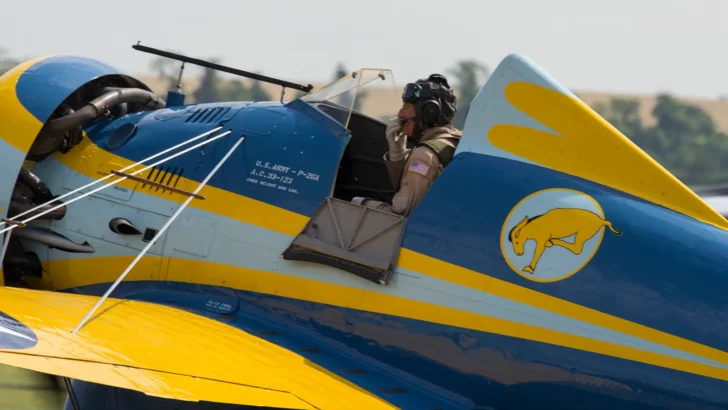
The Boeing P-26 Peashooter is an American single-seat pursuit monoplane developed by the Boeing Airplane Company. As the first all-metal production fighter aircraft and the final pursuit aircraft with braced wings, fixed landing gear, and an open cockpit to enter service with the United States Army Air Corps, it represents an important technological bridge between biplanes and modern World War II monoplanes.
General Information
- Type: Single-seat pursuit fighter
- Manufacturer: Boeing Airplane Company
- First Flight: March 20, 1932
- Status: Retired from active military service
- Primary Users: United States Army Air Corps, Republic of China Air Force, Philippine Army Air Corps, Guatemalan Air Force
- Number Built: 151 units
History
The development of the Boeing P-26 Peashooter began as a private venture initiated by Boeing in 1931 under the designation Model 248, with the U.S. Army supplying engines and instruments. Following favorable evaluations of the prototype—initially designated the XP-936—which made its maiden flight on March 20, 1932, the United States Army Air Corps placed a formal production order for the aircraft. Deliveries of the definitive production variant began in late 1933, establishing the type as a frontline cornerstone for American pursuit groups through the mid-to-late 1930s.
Design
The Boeing P-26 Peashooter features an all-metal semimonocoque fuselage paired with externally braced monoplane wings and a fixed, spatted undercarriage. Power is supplied by a single Pratt & Whitney Wasp air-cooled radial piston engine driving a two-bladed metal propeller. Early operational feedback regarding high landing speeds prompted the retrofitting of split flaps across the fleet, while a distinctive high headrest structure was incorporated into production models to safeguard the pilot during a potential rollover.
Operational Impact
The introduction of the Boeing P-26 Peashooter substantially elevated the speed benchmarks of the U.S. military inventory, serving as the primary pursuit fighter for numerous defense squadrons stationed domestically, in Hawaii, and in the Philippines. Although rapid aviation advancements rendered its open cockpit and fixed landing gear obsolete by the outbreak of World War II, older airframes still engaged in early combat operations over the Philippines and continued secondary defense duties during the early 1940s.
Variants
- XP-936 / Model 248: The initial three prototype aircraft funded for evaluation by the U.S. Army.
- P-26A / Model 266: The primary production variant equipped with a Pratt & Whitney R-1340-27 Wasp radial engine and a taller safety headrest.
- P-26B: An updated variant featuring a fuel-injected Pratt & Whitney R-1340-33 engine.
- P-26C: An interim production version utilizing a carbureted engine setup and a revised fuel delivery system.
- Model 281: The designated export variant supplied to international customers including China and Spain.
Operators
- Current: None (historic preservation fleets and museum collections only)
- Former: United States Army Air Corps, United States Army Air Forces, Philippine Army Air Corps, Republic of China Air Force, and the Guatemalan Air Force
- Future: None (historic aviation legacy only)
Specifications
General Characteristics
- Crew: 1 (pilot)
- Length: 7.18 m
- Wingspan: 8.50 m
- Height: 3.04 m
- Empty Weight: 996 kg
- Maximum Takeoff Weight: 1,524 kg
- Powerplant: 1 × Pratt & Whitney R-1340-27 Wasp 9-cylinder air-cooled radial piston engine, 450 kW (600 hp)
Performance
- Maximum Speed: 377 km/h at an altitude of 1,800 m
- Cruise Speed: 322 km/h
- Combat Range: 580 km
- Service Ceiling: 8,350 m
- Rate of Climb: 3.65 m/s
Armament
- Guns: 2 × 7.62 mm M1919 Browning machine guns or a mixed configuration of 1 × 7.62 mm and 1 × 12.7 mm machine gun
- Bombs: Provision for up to 90 kg of external ordnance carried on underwing racks (typically two 45 kg general-purpose bombs)
The Boeing P-26 Peashooter remains a celebrated milestone in American aeronautical engineering as the vanguard of the nation’s all-metal fighter evolution. Its transitional design bridged the gap between interwar biplanes and the high-performance monoplanes that dominated World War II. Preserved examples today stand as rare testaments to an influential era of military aviation progress.