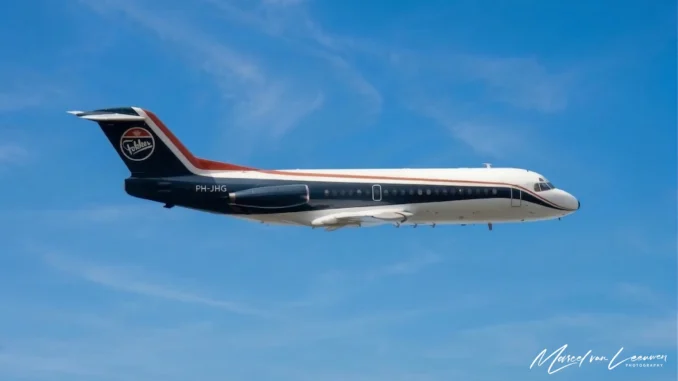
Fokker F28 Fellowship
Introduction
The Fokker F28 Fellowship stands as the Netherlands’ premier short-haul twin-turbofan airliner. Engineered by Dutch manufacturer Fokker, the aircraft bridged regional airfields with major commercial hubs. Featuring tail-mounted Rolls-Royce Spey engines and a distinctive tailcone airbrake, the Fokker F28 pioneered reliable jet transportation on austere runways.
General Information
- Type: Twin-engine short-haul regional jet airliner
- Manufacturer: Fokker (with European consortium partners MBB, VFW, and Short Brothers)
- First Flight: 9 May 1967
- Status: In limited operational service (primarily specialized government and VIP flight roles; retired from major commercial fleets)
- Primary Users: Garuda Indonesia, Ansett Australia, Linjeflyg, Braathens SAFE, NLM CityHopper, Biman Bangladesh Airlines, Piedmont Airlines, USAir, Aerolíneas Argentinas, Philippine Air Force
- Number Built: 241 airframes
History
Fokker launched the F28 programme in April 1962 to develop a jet-powered successor to its successful F27 Friendship turboprop. Designed to serve secondary airfields, the project formed an early European aerospace industrial partnership. The Dutch government funded half of Fokker’s development share, while West Germany and Northern Ireland’s Short Brothers joined risk-sharing consortium agreements to manufacture major airframe sections. Chief test pilot Jas Moll took the initial prototype (PH-JHG) on its maiden flight from Amsterdam Schiphol on 9 May 1967. Following extensive certification, Norwegian launch customer Braathens SAFE inaugurated commercial revenue operations on 28 March 1969.
Design
The Fokker F28 Fellowship features an all-metal low-wing configuration with moderate wing sweep and a distinct T-tail empennage. Two Rolls-Royce RB183 Spey Junior turbofans mount directly onto the aft fuselage. To simplify mechanical systems, eliminate runway debris ingestion, and save structural weight, Fokker engineers omitted thrust reversers. Instead, they implemented full-span wing lift dumpers alongside a hydraulically actuated split tailcone airbrake. This aerodynamic split brake deploys safely during flight or rollout, enabling steep approach gradients and rapid deceleration without compromising engine performance.
Operational Impact
The aircraft transformed regional aviation by bringing high-speed jet travel to secondary domestic networks and remote airstrips. Rugged landing gear and exceptional short-field performance enabled regular scheduled flights from short, unpaved runways across Australasia, Africa, South America, and Scandinavia. The airframe formed the core engineering foundation for the subsequent Fokker 70 and Fokker 100 passenger jet series.
Variants
- Mk 1000: Initial production variant seating 65 to 70 passengers; available with a side cargo door as the Mk 1000C.
- Mk 2000: Fuselage stretch of 2.16 meters accommodating up to 79 passengers.
- Mk 3000: Short fuselage of the Mk 1000 combined with a 1.57-meter wingspan extension and enhanced structural payload capability.
- Mk 4000: Stretched fuselage combined with the extended wingspan, carrying up to 85 passengers.
- Mk 6000: Variant combining the long fuselage with leading-edge wing slats for improved short-field performance.
Operators
- Current: Specialized governmental and military transport units (including the Philippine Air Force).
- Former: Braathens SAFE, Linjeflyg, NLM CityHopper, Garuda Indonesia, Ansett Australia, Pelita Air Service, Aerolíneas Argentinas, Piedmont Airlines, USAir, Air Ontario, Air Ivoire, Biman Bangladesh Airlines, Iberia, and Scandinavian Airlines.
- Future: None (out of commercial production; remaining airframes face scheduled phase-outs).
Specifications (Fokker F28 Mk 4000)
General Characteristics
- Flight Crew: 2 (captain, first officer)
- Length: 29.61 m
- Wingspan: 25.07 m
- Height: 8.47 m
- Wing Area: 78.97 m²
- Empty Weight: 16,144 kg
- Maximum Takeoff Weight: 33,112 kg
- Powerplant: 2 × Rolls-Royce RB183-2 Spey Junior Mk 555-15P turbofans, 43.8 kN thrust each
Performance
- Maximum Speed: 848 km/h
- Cruising Speed: 798 km/h
- Operational Range: 1,700 km (at typical commercial payload)
- Ferry Range: 2,872 km
- Service Ceiling: 10,668 m
- Rate of Climb: 16.5 m/s
Passengers Layout
- Single-Class Configuration: 85 seats arranged five-abreast (3–2 configuration) at a 74 cm seat pitch
- Standard Two-Class / Regional Configuration: 65 to 79 seats at a 79 cm to 81 cm seat pitch
- Cabin Layout: Single central aisle, forward passenger entrance with optional airstairs, two lavatories, forward and aft galleys, and two overwing emergency exits per side
The Fokker F28 Fellowship established an international reputation for structural durability, operational versatility, and unmatched short-runway capability. It successfully lowered the economic barriers to jet operations for regional carriers worldwide, bridging provincial territories into national networks. While commercial airlines have transitioned to modern high-efficiency regional airliners, the F28 retains an enduring engineering legacy as the direct design foundation for the modern Fokker 70 and Fokker 100.