Introduction
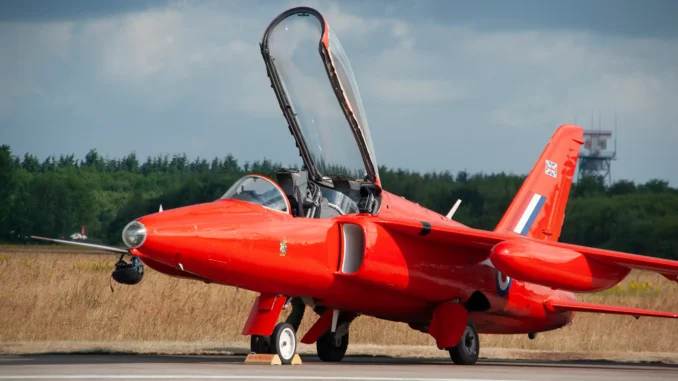
The Folland Gnat (later marketed under Hawker Siddeley) is a compact British swept-wing subsonic jet developed during the 1950s. Designed by W.E.W. Petter as an affordable, lightweight fighter, it achieved renown as an agile combat aircraft for export and served as an advanced transonic trainer with the Royal Air Force.
General Information
- Type: Lightweight fighter / Advanced jet trainer
- Manufacturer: Folland Aircraft (later Hawker Siddeley); built under license by Hindustan Aeronautics Limited (HAL)
- First flight: 18 July 1955 (Gnat prototype)
- Status: Retired
- Primary users: Indian Air Force, Royal Air Force, Finnish Air Force, Yugoslav Air Force
- Number built: Approximately 449 (including licensed Indian production)

History
During the early 1950s, fighter designs grew increasingly heavy, complex, and expensive. Renowned aeronautical engineer W.E.W. Petter envisioned an agile, low-cost lightweight fighter that smaller nations could purchase and maintain easily. Folland financed the concept privately, initially flying the lower-powered Folland Midge in 1954 before flying the true Folland Gnat prototype in July 1955.
Although the British Ministry of Supply evaluated the Gnat, the Royal Air Force rejected it for operational combat roles, choosing instead to procure a tandem two-seat variant as an advanced trainer in 1957. Abroad, India emerged as the primary combat customer. In 1956, the Indian government signed an agreement to purchase Gnat fighters and build the airframe under license at Hindustan Aeronautics Limited.
Design
The airframe featured a shoulder-mounted swept wing with an 8% thickness-to-chord ratio and an integral fuel tank arrangement. Engineers minimized system complexity by utilizing a single hydraulic system and a compact airframe requiring no power boost for the rudder. The landing gear served a secondary purpose as speed brakes. Power came from a single Bristol Orpheus turbojet engine, which delivered high thrust relative to the aircraft’s minimal empty weight.

Operational Impact
The Gnat gained legendary combat status with the Indian Air Force during the Indo-Pakistani Wars of 1965 and 1971. Its diminutive visual profile, exceptional turn rate, and rapid climb performance allowed Indian pilots to engage and outmaneuver significantly larger supersonic fighters like the F-86 Sabre in dogfights, earning the Gnat the nickname “Sabre Slayer.”
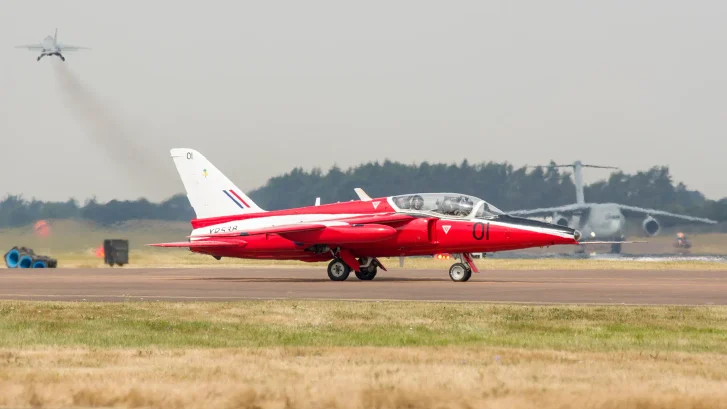
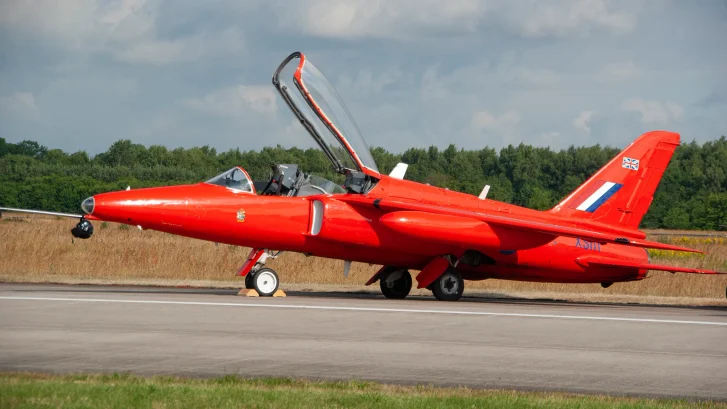
In the United Kingdom, the two-seat Gnat T.1 served as the standard advanced trainer for RAF fast-jet pilots through the 1960s and 1970s. The type achieved widespread public fame as the mount of the RAF’s elite aerobatic display team, the Red Arrows, flying in their signature red livery from 1965 until retirement in 1979.
Variants
- Fo.141 Gnat: Single-seat prototype lightweight fighter.
- Gnat F.1: Production single-seat export fighter built for India and Finland.
- Gnat FR.1: Tactical reconnaissance variant equipped with nose cameras.
- Gnat T.1: Two-seat advanced trainer variant built for the Royal Air Force.
- HAL Ajeet: Extensively upgraded Indian ground-attack/fighter development featuring wet wings and improved avionics.

Operators
- Current: None (military service)
- Former: India, United Kingdom, Finland, Yugoslavia
- Future: None
Specifications (Gnat F.1)
General Characteristics
- Crew: 1
- Length: 8.74 m
- Wingspan: 6.76 m
- Height: 2.46 m
- Wing area: 12.69 m²
- Empty weight: 2,175 kg
- Maximum takeoff weight: 4,100 kg
- Powerplant: 1 × Bristol Siddeley Orpheus 701-01 turbojet, 20.9 kN thrust
Performance
- Maximum speed: 1,120 km/h (Mach 0.98) at 6,100 m
- Combat range: 805 km
- Ferry range: 1,900 km (with external drop tanks)
- Service ceiling: 14,630 m
- Rate of climb: 101.6 m/s
Armament
- Guns: 2 × 30 mm ADEN cannon mounted in the air intake lips (30 rounds per gun)
- Hardpoints: 2 underwing pylons
- Rockets: 12 × 76 mm unguided rockets
- Bombs: Up to 454 kg of conventional bombs (2 × 227 kg bombs)
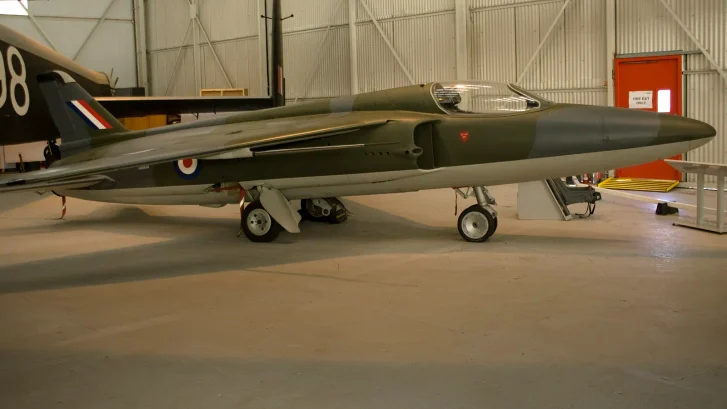
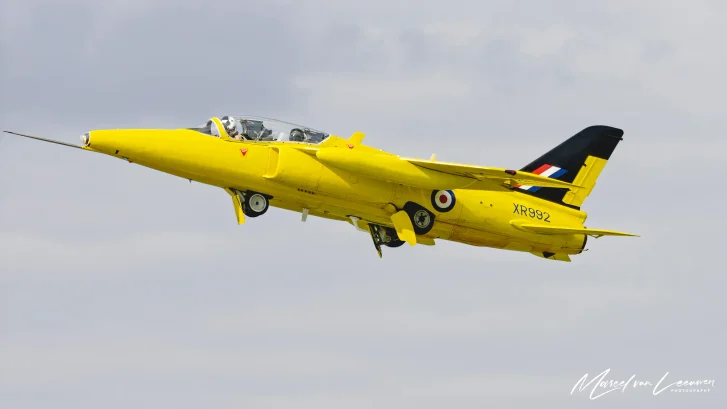
The Folland Gnat demonstrated that compact, cost-effective combat aircraft could successfully counter larger and more expensive supersonic adversaries in frontline aerial warfare. Its operational agility left a lasting impression on post-war tactical doctrine, particularly across South Asia and within military flight training programs. Today, surviving Gnats fly on the civilian airshow circuit and occupy key positions in national aviation museums worldwide.