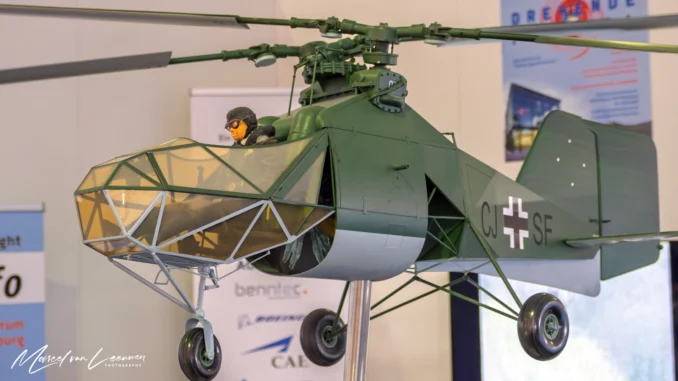
Specifications, History, and Design Fact Sheet
The Flettner Fl 282 Kolibri (Hummingbird) is a German single-seat, single-engine intermeshing-rotor helicopter developed by Anton Flettner during World War II, recognized as the world’s first helicopter to enter series production and operational military service.
General Information
- Type: Reconnaissance and liaison helicopter (synchropter)
- Manufacturer: Anton Flettner Flugzeugbau GmbH
- First flight: 30 October 1941
- Status: Retired (1945)
- Primary users: Kriegsmarine (German Navy) and Luftwaffe (German Air Force)
- Number built: 24 (out of 1,000 ordered)
History
The Flettner Fl 282 Kolibri evolved directly from the experimental Flettner Fl 265, which demonstrated the viability of counter-rotating intermeshing rotors during Kriegsmarine shipboard trials on the light cruiser Köln in 1939 and 1940. Seeking a compact, agile rotorcraft for submarine spotting and convoy escort, the Reich Air Ministry (RLM) awarded Anton Flettner a development contract in 1940 for an improved, production-oriented reconnaissance design.
Prototype Fl 282 V1 completed its maiden flight on 30 October 1941. Extensive sea trials followed in the Baltic, Mediterranean, and Aegean seas throughout 1942 and 1943, proving the aircraft’s ability to operate from small naval landing platforms in rough weather. Impressed by its performance, the RLM ordered 1,000 production helicopters in 1944, with manufacturing split between Flettner and BMW. However, Allied strategic bombing destroyed Flettner’s Munich factory and BMW’s production facilities, limiting total output to 24 completed prototypes and pre-production machines before Germany’s surrender in May 1945.
Design
The Flettner Fl 282 Kolibri utilized a synchropter configuration, pairing two closely spaced, two-bladed intermeshing main rotors angled outward at 12 degrees from the vertical. Synchronized by a precision-machined central gearbox, the counter-rotating blades eliminated torque reaction without requiring an anti-torque tail rotor, improving hover efficiency and compactness.
Its slender fuselage featured a welded steel-tube truss structure skinned with removable metal panels forward and doped fabric over the rear boom. A seven-cylinder, air-cooled Bramo Sh 14A radial piston engine sat centrally inside the fuselage behind the pilot, cooled by a wooden fan and driving the rotors via a lower and upper transmission. The aircraft rode on a fixed tricycle landing gear with a steerable nosewheel. Depending on the variant, the cockpit was either completely open for unobstructed downward visibility or enclosed by a plexiglass canopy, with two-seat models adding a rear-facing observer seat behind the rotor mast.
Operational Impact
The Flettner Fl 282 Kolibri pioneered operational naval helicopter warfare and airborne artillery spotting. During World War II, Fl 282s flew convoy protection and anti-submarine patrols from Kriegsmarine warships—including the cruiser Köln and minelayers Drache and Bulgaria—demonstrating that rotorcraft could safely launch and recover from moving vessels at sea.
In the final months of the war, surviving aircraft were transferred to Transportstaffel 40 (TS/40), the Luftwaffe’s only operational helicopter unit, conducting artillery observation and battlefield liaison missions around Rangsdorf and Bavaria. Although small numbers prevented a strategic impact on the conflict, the Kolibri’s intermeshing-rotor architecture directly influenced postwar American helicopter development, notably Kaman Aircraft’s synchropter designs.
Variants
- Fl 282 V1–V23: Development prototypes and pre-production evaluation airframes testing open cockpits, glazed canopies, horizontal stabilizer designs, and two-seat configurations.
- Fl 282A-1: Single-seat naval reconnaissance variant designed for operation from cruisers and escort warships.
- Fl 282A-2: Proposed single-seat reconnaissance version engineered to fold into a pressurized cylindrical deck hangar on U-boat submarines (project only; never built).
- Fl 282B-0: Single-seat land-based reconnaissance and liaison variant featuring an open, unglazed cockpit.
- Fl 282B-1 / B-2: Land-based reconnaissance and artillery-spotting variants fitted with a plexiglass-glazed cockpit canopy (B-1) and a rear-facing observer position (B-2).
Operators
- Current: None
- Former: Germany (Kriegsmarine and Luftwaffe, Transportstaffel 40); United States and Soviet Union (postwar evaluation of captured examples)
- Future: None
Specifications (Flettner Fl 282 V21)
General Characteristics
- Crew: 1 pilot (2 in Fl 282B-2 observer configuration)
- Length: 6.56 m
- Height: 2.20 m
- Main rotor diameter: 2 × 11.96 m
- Main rotor area: 224.69 m²
- Empty weight: 760 kg
- Maximum takeoff weight: 1,000 kg
- Powerplant: 1 × BMW-Bramo Sh 14A 7-cylinder air-cooled radial piston engine, 119 kW (160 hp)
Performance
- Maximum speed: 150 km/h (at sea level)
- Range: 170 km
- Service ceiling: 3,300 m
- Hover ceiling: 300 m
- Rate of climb: 1.52 m/s
- Rotor loading: 8.84 kg/m²
Armament
- None (unarmed reconnaissance, artillery spotting, and liaison helicopter)
The Flettner Fl 282 Kolibri achieved a landmark milestone in aviation history as the first helicopter placed into series production and deployed in active military service. Its innovative intermeshing rotor system solved torque and stability challenges while proving the value of shipboard rotorcraft. Today, only partial remains survive—most notably the airframe and rotor head of Fl 282 V10 preserved at the Midland Air Museum in Coventry, England.