Specifications, History, and Design Fact Sheet
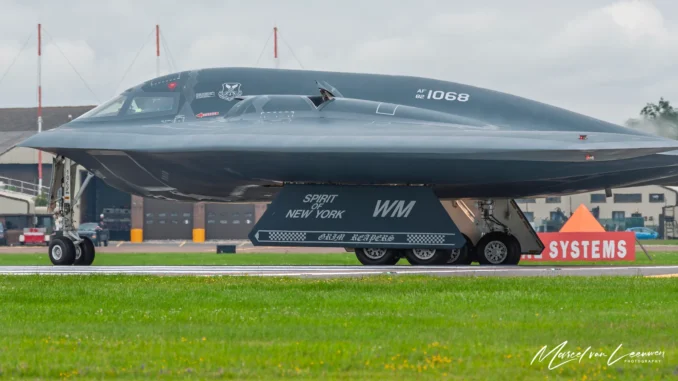
The Northrop Grumman B-2A Spirit is an American heavy strategic stealth bomber featuring a flying-wing configuration and advanced low-observable technology, engineered to penetrate dense anti-aircraft defenses and deliver both conventional and nuclear precision payloads worldwide.
General Information
- Type: Heavy strategic stealth bomber
- Manufacturer: Northrop Grumman (originally Northrop Corporation with major subcontractors Boeing, Hughes, and Vought)
- First flight: 17 July 1989
- Status: In service
- Primary user: United States Air Force
- Number built: 21 (1 prototype converted to operational standard and 20 production aircraft; 19 remain in active service)
History
The Northrop Grumman B-2A Spirit originated in 1979 under the United States Air Force (USAF) Advanced Technology Bomber (ATB) program, initiated during the Carter administration to counter increasingly sophisticated Soviet integrated air defense networks. Drawing on experience from earlier flying-wing prototypes such as the YB-35 and YB-49, Northrop partnered with Boeing, Hughes Aircraft, and Vought to compete against a rival Lockheed–Rockwell consortium.
On 20 October 1981, the USAF selected the Northrop ATB proposal, officially designating the aircraft the B-2 and later naming it Spirit. Developed under strict secrecy at Palmdale, California, the first prototype (AV-1, serial 82-1066) rolled out on 22 November 1988 and completed its maiden flight on 17 July 1989.
Although the USAF originally planned to acquire 132 bombers, the dissolution of the Soviet Union and escalating unit costs led the U.S. government in the early 1990s to cap production at 21 aircraft. Initial operational deliveries began in December 1993 to the 509th Bomb Wing at Whiteman Air Force Base, Missouri, and the fleet achieved full operational capability in 2003.
Design
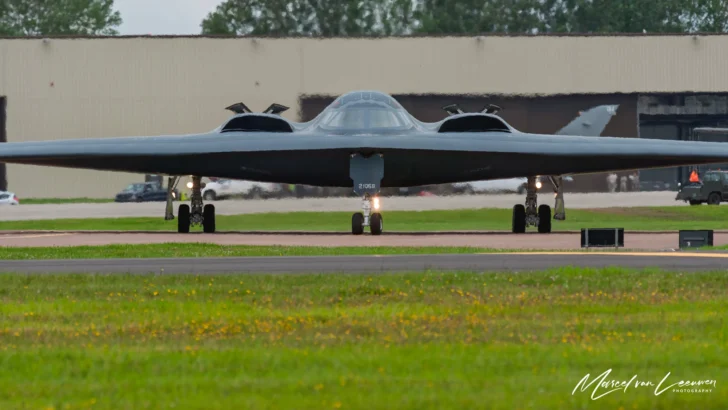
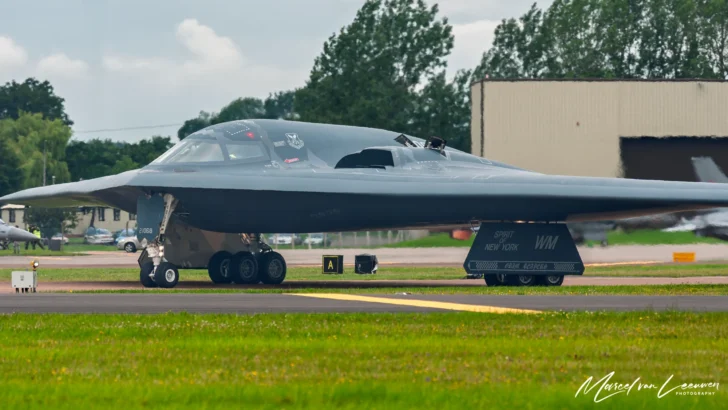
The Northrop Grumman B-2A Spirit employs a pure flying-wing planform with no vertical tail surfaces or fuselage, reducing aerodynamic drag while eliminating radar-reflective corner angles. Its leading edges sweep back at 33 degrees, while the trailing edge forms a distinctive double-W (“sawtooth”) pattern designed to scatter incoming radar energy away from enemy receivers.
Constructed primarily of carbon-graphite composite materials coated with specialized radar-absorbent material (RAM), the airframe achieves an exceptionally low radar cross-section. Four General Electric F118-GE-100 non-afterburning turbofan engines sit buried deeply within the upper wing structure, utilizing S-shaped intake ducts to shield compressor blades from radar detection and mixing exhaust gases with cool ambient air to suppress infrared signatures.
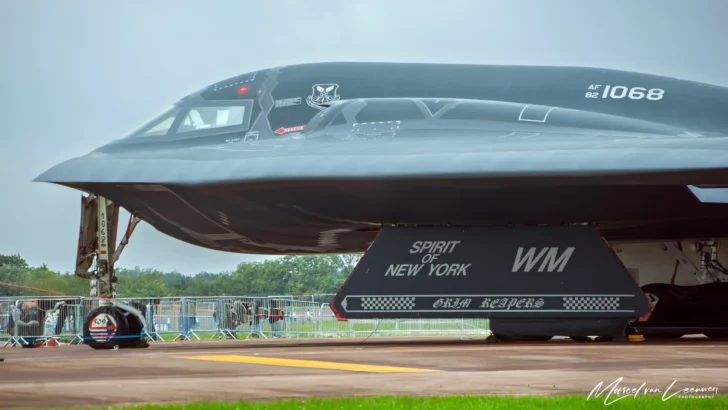
A quadruple-redundant digital fly-by-wire (FBW) flight control system automatically manages pitch, roll, and yaw via split drag rudders and elevons, maintaining stability without vertical stabilizers. The two-person glass cockpit accommodates a pilot and a mission commander sitting side-by-side on ACES II ejection seats, supported by a rest area and galley for ultra-long-range global missions.
Operational Impact
The B-2A Spirit revolutionized long-range strike warfare by enabling the United States Air Force to strike heavily defended, high-value targets anywhere on Earth within hours of launch. The aircraft made its combat debut during Operation Allied Force in 1999, flying nonstop 30-hour round-trip missions from Whiteman Air Force Base to Kosovo and delivering Joint Direct Attack Munition (JDAM) satellite-guided bombs with pinpoint accuracy.
Subsequent combat deployments included Operation Enduring Freedom in Afghanistan (2001), Operation Iraqi Freedom (2003)—where a single B-2 conducted a record 44-hour combat sortie—Operation Odyssey Dawn in Libya (2011), and precision strikes in Yemen (2017 and 2024). By combining stealth, intercontinental unrefueled range, and heavy internal payload capacity, the B-2A established the operational doctrine for modern low-observable strategic bombers.
Variants
- B-2A Block 10: Initial production configuration capable of carrying B83 nuclear bombs and Mk 84 conventional munitions (16 built; later upgraded).
- B-2A Block 20: Intermediate upgrade introducing limited Joint Direct Attack Munition (JDAM) capability and the GPS-Aided Targeting System (GATS).
- B-2A Block 30: Standardized full-capability operational configuration incorporating full RAM stealth treatments, AN/APQ-181 low-probability-of-intercept radar enhancements, Link 16 tactical data links, EHF satellite communications, and integration of JASSM cruise missiles and GBU-57 Massive Ordnance Penetrator bunker-buster bombs (all surviving airframes upgraded to this baseline).
Operators
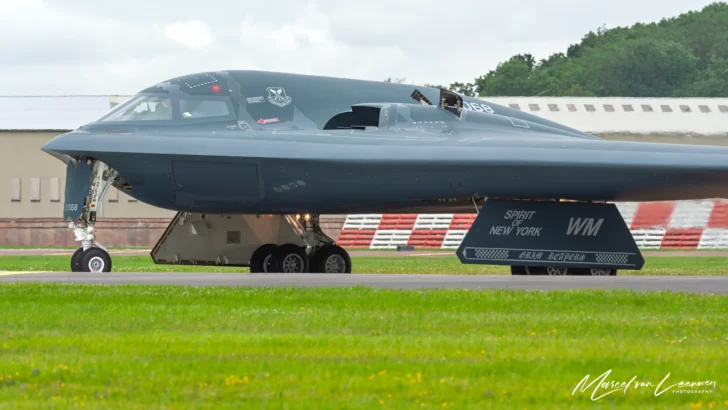
- Current: United States Air Force (Air Force Global Strike Command — 509th Bomb Wing and Missouri Air National Guard 131st Bomb Wing at Whiteman Air Force Base, Missouri; 412th Test Wing at Edwards Air Force Base, California).
- Former: None
- Future: None (scheduled for gradual retirement in the 2030s as the Northrop Grumman B-21 Raider enters frontline service).
Specifications (Northrop Grumman B-2A Spirit)
General Characteristics
- Crew: 2 (pilot in left seat and mission commander in right seat)
- Length: 21.0 m
- Wingspan: 52.4 m
- Height: 5.18 m
- Wing area: 478.0 m²
- Empty weight: 71,700 kg
- Loaded weight: 152,200 kg
- Maximum takeoff weight: 170,600 kg
- Fuel capacity: 75,750 kg
- Powerplant: 4 × General Electric F118-GE-100 non-afterburning turbofan engines, 77 kN thrust each
Performance
- Maximum speed: 1,010 km/h (Mach 0.95) at 12,190 m altitude
- Cruise speed: 900 km/h (Mach 0.85) at 12,190 m altitude
- Range: 11,100 km (unrefueled; over 18,500 km with a single aerial refueling)
- Service ceiling: 15,240 m
- Wing loading: 329 kg/m²
- Thrust-to-weight ratio: 0.205
Armament
- Internal weapons bays: 2 side-by-side center-fuselage bays with a total payload capacity of 18,144 kg (up to 23,000 kg structural limit), fitted with Rotary Launcher Assemblies (RLA) or smart bomb racks
- Conventional bombs: Up to 80 × 227 kg Mk 82 or GBU-38 JDAM bombs, 36 × 340 kg CBU cluster munitions, 16 × 907 kg Mk 84 or GBU-31 JDAM bombs, or 2 × 13,600 kg GBU-57A/B Massive Ordnance Penetrator (MOP) bunker-busters
- Stand-off missiles: Up to 16 × AGM-154 Joint Standoff Weapon (JSOW) or AGM-158 JASSM / JASSM-ER stealth cruise missiles
- Nuclear weapons: Up to 16 × B61-7, B61-11, B61-12, or B83-1 thermonuclear gravity bombs
The Northrop Grumman B-2A Spirit stands as a landmark achievement in aerospace engineering, combining a radar-evading flying-wing airframe with global strategic reach. For more than three decades, it has served as the premier penetrating strike asset of the United States Air Force, executing some of the longest combat sorties in aviation history. Ongoing avionics and defensive system upgrades will keep the 19 surviving B-2A aircraft operational until the Northrop Grumman B-21 Raider assumes full strategic deterrence duties in the 2030s.