Specifications, History, and Design Fact Sheet
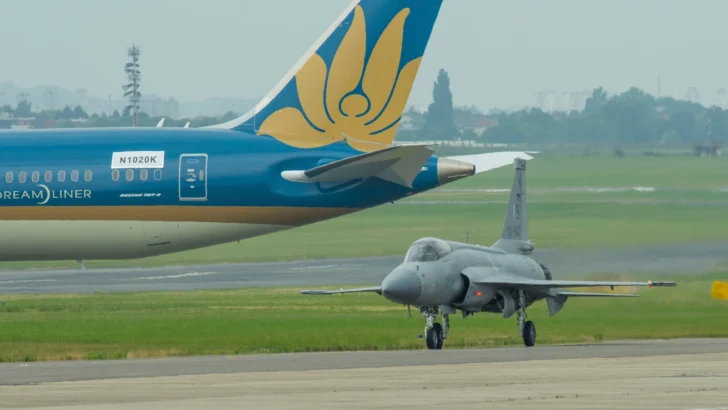
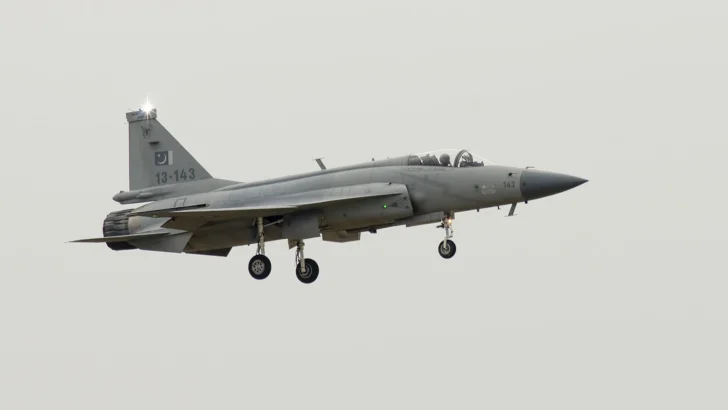
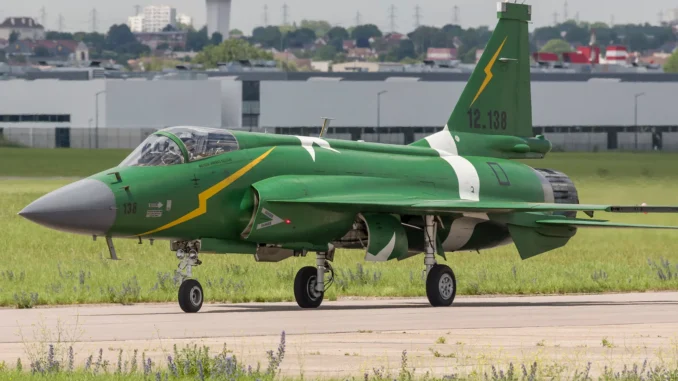
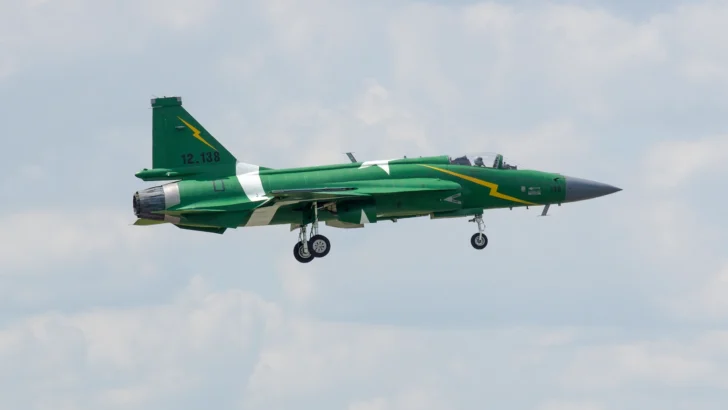
The PAC/CAC JF-17 Thunder (designated FC-1 Xiaolong in China) is a lightweight, single-engine, fourth-generation multirole combat aircraft jointly developed by the Pakistan Aeronautical Complex (PAC) and the Chengdu Aircraft Corporation (CAC) to modernize the Pakistan Air Force and serve export markets.
General Information
- Type: Lightweight multirole combat aircraft
- Manufacturer: Pakistan Aeronautical Complex (PAC) and Chengdu Aircraft Corporation (CAC)
- First flight: 25 August 2003 (Prototype PT-01)
- Status: In service
- Primary users: Pakistan Air Force, Myanmar Air Force, Nigerian Air Force, Azerbaijani Air Force, Iraqi Air Force (ordered)
- Number built: Over 180 (production ongoing)
History
The JF-17 Thunder originated in the late 1980s and early 1990s under the Super-7 fighter program, initially explored by China’s Chengdu Aircraft Corporation (CAC) and Grumman Aerospace to upgrade the Chengdu J-7. Following U.S. sanctions in 1989 and 1990—which halted Grumman’s participation and blocked Pakistan’s delivery of new General Dynamics F-16 fighters—Pakistan and China signed a formal memorandum of understanding in 1995 to jointly develop and co-produce an affordable, modern multirole fighter.
Designated JF-17 (Joint Fighter-17) by Pakistan and FC-1 Xiaolong (Fierce Dragon) by China, the program officially entered full-scale development in June 1999. The first prototype (PT-01) completed its maiden flight in Chengdu on 25 August 2003, followed by a redesigned fourth prototype (PT-04) featuring diverterless supersonic inlets (DSI) in April 2006.
Small-batch deliveries to the Pakistan Air Force (PAF) began in 2007, and the first operational squadron, No. 26 Squadron “Black Spiders”, officially inducted the aircraft in February 2010. Pakistan Aeronautical Complex (PAC) in Kamra manufactures approximately 58 percent of the airframe and performs final assembly for Pakistani and export orders.
Design
The JF-17 Thunder features a semi-monocoque conventional aluminum-alloy airframe integrated with high-strength composite materials in the empennage and control surfaces to reduce structural weight. Its mid-mounted cropped-delta wing incorporates large leading-edge root extensions (LERX) that generate controlled vortex lift at high angles of attack, enhancing maneuverability during close air combat.
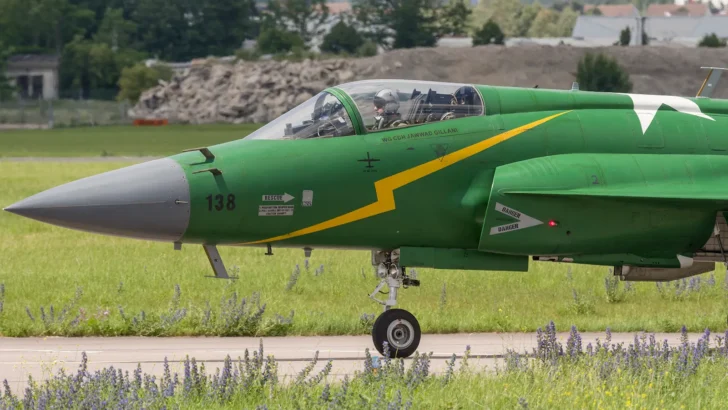
Beginning with prototype PT-04, the aircraft adopted diverterless supersonic inlets (DSI), which eliminate heavy mechanical splitter plates, reduce radar cross-section, and optimize airflow to the single Klimov RD-93 (or Chinese Guizhou WS-13) afterburning turbofan engine. Flight control relies on a hybrid fly-by-wire (FBW) system—upgraded to a full three-axis digital fly-by-wire architecture on the Block III variant—paired with hands-on-throttle-and-stick (HOTAS) controls and a glass cockpit featuring three large multi-function displays (MFDs) and a wide-angle head-up display (HUD).
Operational Impact
The JF-17 Thunder transformed the Pakistan Air Force by replacing aging Chengdu F-7, Nanchang A-5, and Dassault Mirage III/5 fleets with a unified, digitally networked multirole platform capable of beyond-visual-range (BVR) interception, precision ground strike, and maritime anti-ship operations. Because Pakistan controls domestic maintenance, avionics software integration, and weapons certification, the PAF gained strategic independence from Western arms embargoes.
The aircraft saw combat deployment during Operation Swift Retort in February 2019 and subsequent border security operations. Internationally, the JF-17 established itself as a cost-effective alternative to Western and Russian fourth-generation fighters for developing air forces seeking modern AESA radar and precision-guided munitions on a constrained defense budget.
Variants
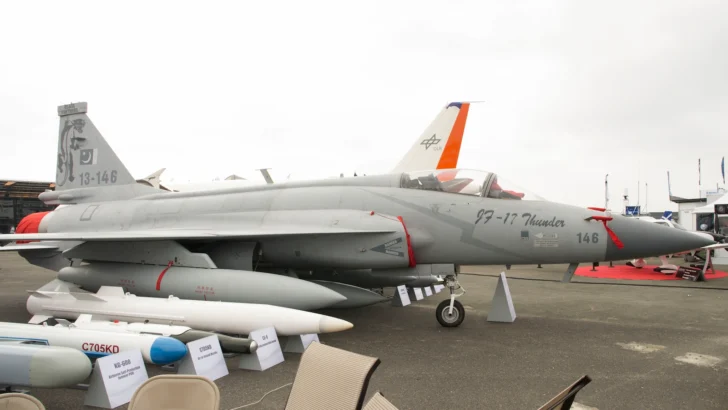
- JF-17 Block I: Initial production standard equipped with the NRIET KLJ-7 pulse-Doppler fire-control radar, RD-93 engine, and a hybrid fly-by-wire system (50 built for the PAF).
- JF-17 Block II: Improved variant introducing a fixed aerial refueling probe, upgraded avionics, enhanced electronic warfare suites, expanded air-to-ground weapon compatibility, and increased composite usage (62 built for the PAF plus export airframes).
- JF-17B: Two-seat operational conversion trainer and combat-capable variant featuring an extended dorsal spine for additional fuel and avionics; first flew on 27 April 2017.
- JF-17 Block III: Advanced 4.5-generation production standard incorporating the NRIET KLJ-7A active electronically scanned array (AESA) radar, a full three-axis digital fly-by-wire system, a helmet-mounted display and sight (HMD/S), an infrared search and track (IRST) sensor, an upgraded RD-93MA engine, and integration of PL-15E long-range BVR missiles.
Operators
- Current: Pakistan Air Force (over 150 aircraft across Blocks I, II, B, and III), Myanmar Air Force (16 JF-17M/B delivered), Nigerian Air Force (3 JF-17 Block II operated), and Azerbaijani Air Force (deliveries of Block III commenced in 2024–2025).
- Former: None
- Future: Iraqi Air Force (contracted for 12 JF-17 Block III fighters).
Specifications (JF-17 Block III)
General Characteristics
- Crew: 1 (2 in JF-17B)
- Length: 14.32 m
- Wingspan: 9.45 m (including wingtip missile rails)
- Height: 4.57 m
- Wing area: 24.4 m²
- Empty weight: 6,586 kg
- Loaded weight: 9,100 kg
- Maximum takeoff weight: 13,500 kg
- Internal fuel capacity: 2,350 kg
- Powerplant: 1 × Klimov RD-93MA afterburning turbofan engine, 50.0 kN dry thrust / 91.2 kN with afterburner
Performance
- Maximum speed: 1,960 km/h (Mach 1.6) at high altitude
- Combat radius: 1,352 km
- Ferry range: 3,482 km (with three external drop tanks)
- Service ceiling: 16,920 m
- Thrust-to-weight ratio: 1.07 (at normal loaded weight)
- G-limits: +8.5 / −3.0 g
Armament
- Guns: 1 × 23 mm GSh-23-2 twin-barrel autocannon (or 30 mm Type 30-1 single-barrel cannon), 180 rounds
- Hardpoints: 8 total (2 wingtip, 4 underwing, 1 centerline, and 1 chin sensor/pod station) with a maximum external payload of 4,300 kg
- Air-to-air missiles: PL-5EII, PL-9C, PL-10E (short-range infrared), SD-10A (PL-12), and PL-15E (beyond-visual-range active radar-guided)
- Air-to-surface & anti-ship missiles: C-802AK, CM-400AKG supersonic anti-ship/land-attack missile, MAR-1 anti-radiation missile, and Ra’ad air-launched cruise missile
- Bombs: LS-6 satellite-guided glide bombs, GBU-10/12 laser-guided bombs, REK range-extension kits, and conventional general-purpose bombs
The PAC/CAC JF-17 Thunder demonstrates how bilateral industrial cooperation can deliver a capable, upgradable multirole fighter at a fraction of the cost of comparable Western platforms. Forming the numerical backbone of the Pakistan Air Force, the aircraft has steadily evolved from a lightweight day fighter into an AESA-equipped 4.5-generation combat jet. Continued Block III production and growing international export orders ensure the Thunder will remain active in frontline service well into the 2040s.