Specifications, History, and Design Fact Sheet
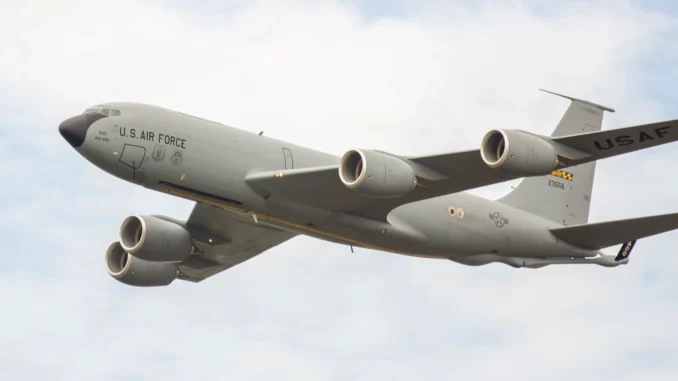
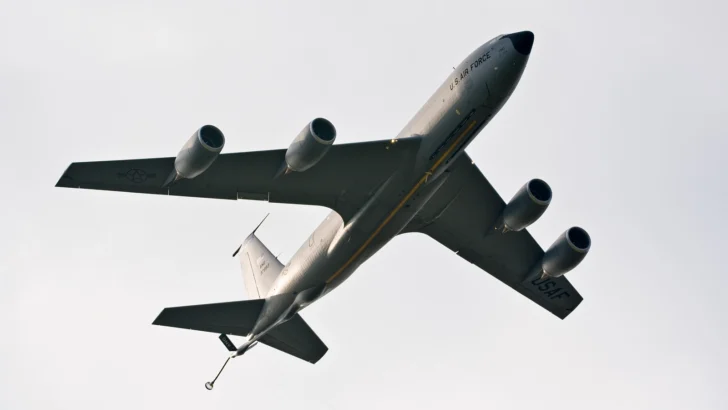
The Boeing KC-135 Stratotanker is a four-engine, swept-wing military aerial refueling tanker and transport aircraft developed for the United States Air Force, providing long-range global power projection for American and allied combat aircraft since entering service in 1957.
General Information
- Type: Aerial refueling tanker and military transport aircraft
- Manufacturer: Boeing
- First flight: 31 August 1956
- Status: In service
- Primary users: United States Air Force, Turkish Air Force, Chilean Air Force, Indian Air Force, French Air and Space Force (former), Republic of Singapore Air Force (former)
- Number built: 803 (820 total including C-135 variants)
History
The Boeing KC-135 Stratotanker originated in the early 1950s when the United States Air Force (USAF) required a high-speed, jet-powered tanker capable of refueling the Strategic Air Command (SAC) fleet of jet bombers, such as the Boeing B-47 Stratojet and B-52 Stratofortress. Existing piston-engine tankers like the KC-97 Stratofreighter flew too slowly and at altitudes too low for efficient jet refueling.
To demonstrate a multi-purpose jet platform, Boeing invested private funds to build the Model 367-80 (“Dash 80”) prototype, which first flew on 15 July 1954. Although Lockheed won the initial design competition, the USAF selected Boeing’s Model 717 (designated KC-135A) in 1954 because Boeing could deliver operational aircraft much sooner. The USAF placed an initial order for 29 aircraft in August 1954.
The first production KC-135A completed its maiden flight on 31 August 1956, and operational deliveries began in June 1957 to Castle Air Force Base, California. Production continued at Boeing’s Renton, Washington facility until 1965, yielding 803 tankers. Over subsequent decades, major re-engining and avionics modernization programs kept the airframe operationally relevant well into the 21st century.
Design
Although visually similar to the commercial Boeing 707, the KC-135 Stratotanker was engineered independently from the Dash 80 prototype with a narrower fuselage (3.66 m diameter), shorter length, and reinforced structural frame tailored for heavy fuel loads. It features a 35-degree swept low wing carrying four pod-mounted engines.
The aircraft stores aviation fuel in bladder and integral tanks throughout the wings and lower fuselage, leaving the upper main deck unobstructed for cargo pallets, passengers, or aeromedical evacuation litters. Fuel transfer is controlled by a boom operator stationed in a prone compartment at the rear fuselage, operating Boeing’s high-speed telescoping flying boom equipped with aerodynamic ruddevators. To support probe-equipped U.S. Navy, Marine Corps, and allied aircraft, the KC-135 can mount a boom drogue adapter or underwing Multipoint Refueling System (MPRS) hose-and-drogue pods.
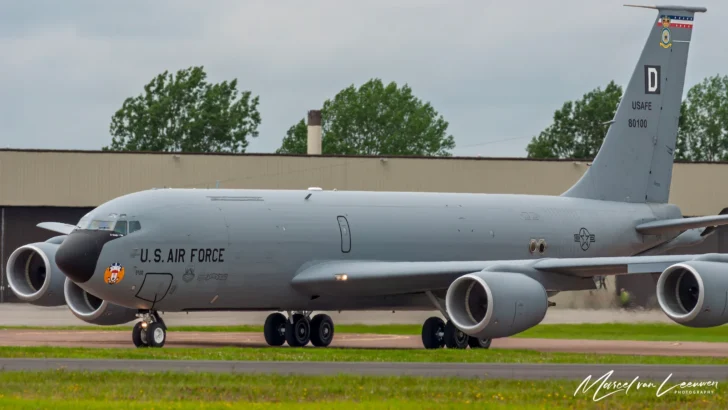
Originally powered by noisy, water-injected Pratt & Whitney J57 turbojets, the surviving fleet underwent major upgrades in the 1980s and 1990s. Re-engining with high-bypass CFM International F108 (CFM56) turbofans drastically reduced noise and fuel burn while increasing fuel offload capacity by up to 50 percent.
Operational Impact
The KC-135 Stratotanker transformed modern military aviation by giving strategic bombers, tactical fighters, and transport aircraft true intercontinental endurance. During the Cold War, the aircraft sustained continuous airborne alert operations for Strategic Air Command nuclear bombers and later conducted specialized refueling missions for the Lockheed SR-71 Blackbird.
Beginning with the Vietnam War, the Stratotanker became an indispensable force multiplier in every major U.S. and coalition air campaign, including Operation Desert Storm (1991), operations over the Balkans, Operation Enduring Freedom, and Operation Iraqi Freedom. Its modular fuselage design also spawned an extensive family of specialized intelligence, command-and-control, and weather reconnaissance platforms that remain central to global military operations.
Variants
- KC-135A: Original production tanker powered by four Pratt & Whitney J57-P-59W turbojets (732 built).
- KC-135E: Air National Guard and Air Force Reserve tankers re-engined with Pratt & Whitney TF33-PW-102 turbofans salvaged from retired Boeing 707 airliners (161 converted; retired in 2009).
- KC-135Q: Modified KC-135A tankers featuring separated fuel systems to carry specialized JP-7 fuel for the Lockheed SR-71 Blackbird (56 converted).
- KC-135R: Primary modernized variant re-engined with four CFM International F108-CF-100 (CFM56-2) turbofans, upgraded landing gear, and modernized Block 45 digital glass cockpits (over 420 converted).
- KC-135T: Re-engined KC-135Q airframes fitted with F108 turbofans while retaining split fuel tank capabilities (54 converted).
- C-135F / C-135FR: Dual-role tanker/transport aircraft built specifically for France (12 built), later upgraded to C-135FR standard with CFM56 engines.
- Related C-135 Derivatives: Includes the C-135 Stratolifter transport, EC-135 airborne command post, RC-135 reconnaissance aircraft, WC-135 atmospheric collection aircraft, OC-135B Open Skies observation aircraft, and NC-135/NKC-135 testbeds.
Operators
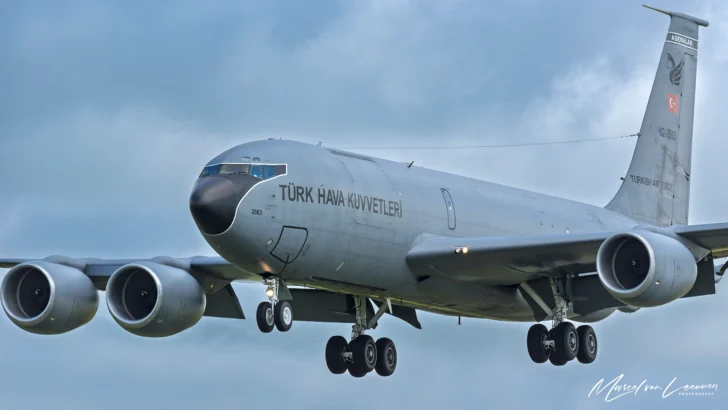
- Current: United States Air Force (Active Duty, Air Force Reserve, and Air National Guard), Turkish Air Force, Chilean Air Force, Indian Air Force (1 leased/operated for training and support), and private contractor Metrea Strategic Mobility (operating former French and Singaporean tankers).
- Former: French Air and Space Force (retired in 2023–2024), Republic of Singapore Air Force (retired in 2019), and NASA (operated modified KC-135A/NKC-135A aircraft for reduced-gravity astronaut training).
- Future: None (no new operators scheduled as fleets transition to the Boeing KC-46 Pegasus and Airbus A330 MRTT).
Specifications (KC-135R Stratotanker)
General Characteristics
- Crew: 3 (pilot, copilot, and boom operator; navigator added on specialized missions)
- Capacity: Up to 37 passengers (80 in high-density seating), 6 standard 463L cargo pallets, or 37,650 kg maximum cargo payload
- Length: 41.53 m
- Wingspan: 39.88 m
- Height: 12.70 m
- Wing area: 226.0 m²
- Empty weight: 44,630 kg (56,245 kg operating empty weight)
- Gross weight: 134,717 kg
- Maximum takeoff weight: 146,284 kg
- Maximum fuel capacity: 90,718 kg (112,995 L)
- Powerplant: 4 × CFM International F108-CF-100 turbofan engines, 96.2 kN thrust each
Performance
- Maximum speed: 933 km/h (Mach 0.90)
- Cruise speed: 850 km/h at 9,144 m
- Range: 2,419 km (with 68,039 kg of transferable fuel)
- Ferry range: 17,727 km
- Service ceiling: 15,240 m
- Rate of climb: 24.9 m/s
Armament
- None (unarmed support and aerial refueling tanker)
The Boeing KC-135 Stratotanker stands as one of the longest-serving and most consequential military support aircraft in aviation history. By pioneering high-speed jet-to-jet aerial refueling, it enabled global reach for modern air forces across seven decades of deterrence and combat operations. Although the Boeing KC-46 Pegasus is gradually replacing older airframes, continuous structural and avionics upgrades are expected to keep the KC-135R and KC-135T in frontline U.S. Air Force service into the 2040s.