Boeing 707: Technical Specifications, History, and Design Fact Sheet
The Boeing 707 is a mid- to long-range, narrow-body, four-engine commercial jet airliner that inaugurated the global jet age, transforming international air travel with its swept-wing aerodynamics, podded engines, and unprecedented transoceanic speed and passenger capacity.
General Information
- Type: Narrow-body jet airliner
- Manufacturer: Boeing Commercial Airplanes
- First flight: 20 December 1957 (production 707-120; Model 367-80 prototype flew on 15 July 1954)
- Status: Retired from commercial service (limited military and specialized operations continue)
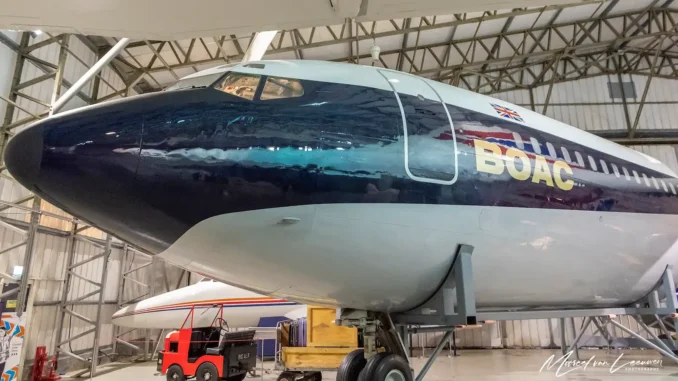
- Primary users: Pan American World Airways, Trans World Airlines (TWA), American Airlines, Air France, BOAC, Lufthansa, Qantas, Continental Airlines
- Number built: 865 commercial airframes (1,010 total including military derivatives and the Boeing 720)
History
The Boeing 707 originated in 1952 when Boeing committed private company funds to develop a swept-wing jet transport prototype known as the Model 367-80 (“Dash 80”). Designed to serve both as a commercial airliner demonstrator and an aerial refueling tanker for the United States Air Force (USAF), the Dash 80 completed its maiden flight on 15 July 1954. While the USAF ordered the tanker variant as the KC-135 Stratotanker, commercial airlines initially hesitated until Boeing widened the production fuselage to accommodate six-abreast economy seating.
In October 1955, Pan American World Airways placed the launch order for 20 Boeing 707-120 aircraft, followed quickly by American Airlines and other major carriers. The first production 707-120 flew on 20 December 1957, and Pan Am inaugurated scheduled transatlantic jet service between New York and Paris on 26 October 1958. Continuous aerodynamic and engine refinements produced longer-range intercontinental models throughout the 1960s, while commercial production concluded in 1978 (with specialized military airframes built until 1991).
Design
The Boeing 707 established the structural template for modern commercial jetliners. It featured a low-mounted 35-degree swept wing carrying four engines mounted in individual underwing pods ahead of the wing’s leading edge. Placing the engines in pods improved maintenance accessibility, reduced cabin noise, and acted as mass balances to suppress wing flutter.
Early production models utilized Pratt & Whitney JT3C or JT4A turbojet engines, whereas later variants adopted quieter, more fuel-efficient Pratt & Whitney JT3D turbofans or Rolls-Royce Conway bypass turbojets. The pressurized circular aluminum fuselage measured 3.76 m in external width, enabling high-density six-abreast seating and spacious underfloor cargo holds. Advanced high-lift devices, including leading-edge Krueger flaps and double-slotted trailing-edge flaps, allowed the aircraft to operate from existing major municipal runways.
Operational Impact
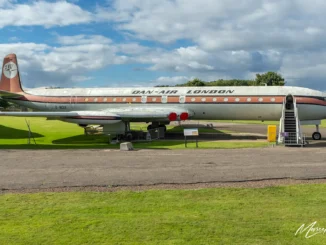
Although the British de Havilland Comet entered service first, the Boeing 707 became the first commercially successful jet airliner and catalyzed the global Jet Age. By cruising at altitudes above 10,000 m at speeds approaching 960 km/h, the 707 cut transatlantic crossing times nearly in half compared to piston-engine airliners like the Douglas DC-7 and Lockheed Constellation.
Its high productivity, mechanical reliability, and lower seat-mile operating costs democratized intercontinental air travel, causing passenger air traffic to surpass ocean liners and long-distance passenger trains by the early 1960s. Furthermore, Boeing retained the 707’s upper fuselage cross-section and nose architecture for the Boeing 720, 727, 737, and 757, creating an enduring family lineage.
Variants
- 707-120: Initial production variant powered by four Pratt & Whitney JT3C-6 turbojets, engineered primarily for transcontinental routes.
- 707-138: Shortened-fuselage, long-range version built exclusively for Qantas (7 built).
- 707-220: High-altitude, hot-weather variant equipped with higher-thrust Pratt & Whitney JT4A-3 turbojets, operated by Braniff International (5 built).
- 707-320 Intercontinental: Stretched long-range model featuring a larger wing, greater fuel capacity, and JT4A engines for nonstop transoceanic operations.
- 707-420: Intercontinental variant identical to the -320 airframe but powered by four Rolls-Royce Conway turbofan engines.
- 707-120B / 707-320B: Improved turbofan-powered models fitted with Pratt & Whitney JT3D engines and aerodynamic wing modifications for extended range and lower fuel consumption.
- 707-320C: Convertible passenger/cargo variant incorporating a reinforced cabin floor and a large forward main-deck cargo door.
- Boeing 720: Shortened, lightweight derivative optimized for short- to medium-range flights from shorter runways (154 built).
- Military Variants: Includes the VC-137 presidential/VIP transport (“Air Force One”), E-3 Sentry (AWACS), E-6 Mercury, and E-8 Joint STARS.
Operators
- Current: United States Air Force (E-3, E-8, and specialized derivatives), NATO, Royal Saudi Air Force, Islamic Republic of Iran Air Force, Israeli Air Force, Chilean Air Force, and Omega Aerial Refueling Services (no commercial passenger airlines remain in operation).
- Former: Pan American World Airways, Trans World Airlines, American Airlines, Air France, BOAC, Lufthansa, Qantas, Sabena, Varig, Saha Airlines (final commercial operator, ending scheduled passenger flights in 2013), and dozens of global flag carriers and cargo airlines.
- Future: None
Specifications (Boeing 707-320B)
General Characteristics
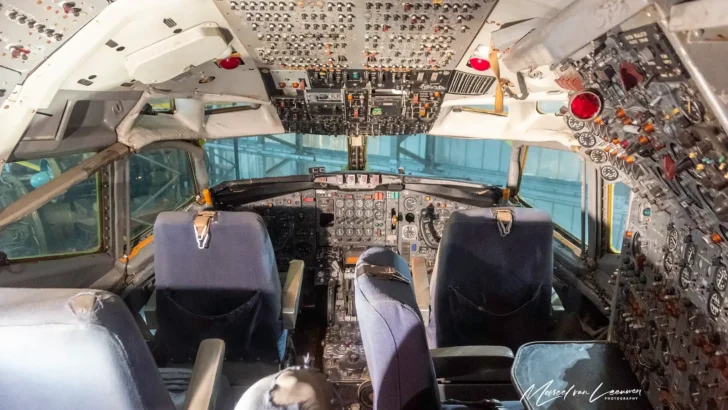
- Crew: 3 to 4 (captain, first officer, flight engineer, and navigator on early long-range flights)
- Length: 46.61 m
- Wingspan: 44.42 m
- Height: 12.93 m
- Wing area: 283.4 m²
- Fuselage width: 3.76 m
- Empty weight: 67,500 kg
- Maximum takeoff weight: 151,300 kg
- Fuel capacity: 90,300 L
- Powerplant: 4 × Pratt & Whitney JT3D-3B turbofan engines, 80 kN thrust each
Performance
- Maximum speed: 972 km/h (Mach 0.88)
- Cruise speed: 885 to 965 km/h
- Range: 9,300 km (with typical passenger payload)
- Service ceiling: 11,885 m
- Takeoff distance: 3,000 m
- Landing distance: 1,800 m
Passengers Layout
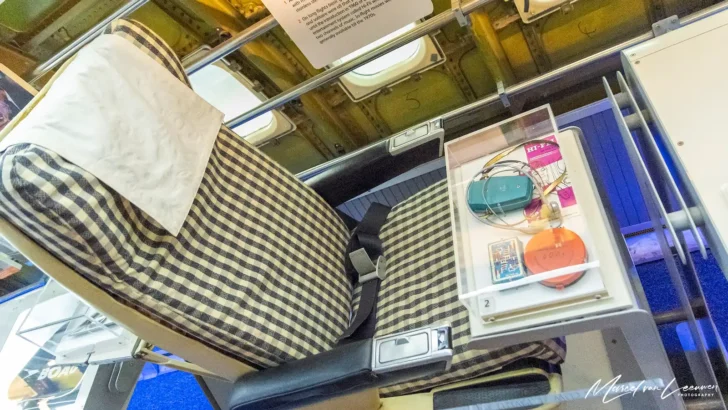
- Two-class configuration: 147 to 165 passengers (First Class four-abreast and Economy Class six-abreast)
- Single-class high-density layout: Up to 189 passengers (219 passengers maximum in convertible 707-320C charter layouts)
- Cabin layout: Single central aisle with three-plus-three (3-3) economy seating
The Boeing 707 revolutionized global transportation by establishing swept-wing, podded-engine jetliners as the industry standard for long-distance travel. Its commercial success secured Boeing’s leadership in civil aviation and laid the structural foundation for subsequent generations of narrow-body airliners. Although retired from scheduled passenger service, specialized military derivatives derived from the 707 airframe continue to perform strategic airborne early warning and communications missions worldwide.