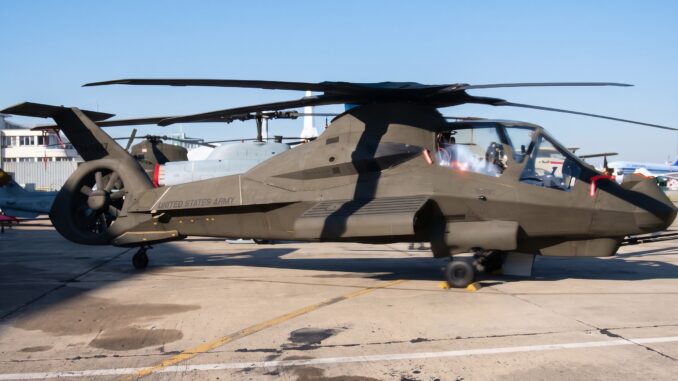
The Boeing–Sikorsky RAH-66 Comanche was an advanced two-seat, twin-engine stealth armed reconnaissance and light attack helicopter developed for the United States Army, pioneering low-observable rotorcraft technology before its cancellation in 2004.
General Information
- Type: Armed reconnaissance and attack helicopter
- Manufacturer: Boeing Helicopters and Sikorsky Aircraft
- First flight: 4 January 1996
- Status: Cancelled (23 February 2004)
- Primary user: United States Army (intended)
- Number built: 2 prototypes
History
The RAH-66 Comanche originated in the early 1980s under the United States Army’s Light Helicopter Experimental (LHX) program. The Army sought a modern replacement for its aging fleet of Bell OH-58 Kiowa observation helicopters and Bell AH-1 Cobra light attack rotorcraft. In June 1985, Boeing Helicopters and Sikorsky Aircraft formed the “First Team” joint venture to compete against a rival consortium of Bell Helicopter and McDonnell Douglas.
Following formal requests for proposals in June 1988 and a demonstration/validation phase, the United States Army selected the Boeing–Sikorsky team in April 1991 to develop the RAH-66 Comanche. Boeing assumed responsibility for mission equipment package integration, flight controls, the aft fuselage, and rotor blades, while Sikorsky led airframe integration, dynamics, the rotor hub, and cockpit design.
Prototype 94-0327 completed its maiden flight on 4 January 1996, followed by the second prototype, 95-0001, on 30 March 1999. Despite successful flight testing, escalating development costs, weight growth, and shifting battlefield requirements led Acting Secretary of the Army Les Brownlee and Army Chief of Staff General Peter Schoomaker to terminate the program on 23 February 2004. Nearly $7 billion had been invested before mass production began, and funds were redirected toward upgrading existing helicopters and accelerating unmanned aerial vehicle (UAV) programs.
Design
The RAH-66 Comanche incorporated extensive low-observable (stealth) features designed to minimize radar, infrared, acoustic, and visual signatures. Its airframe utilized composite materials and angular, faceted surfaces to deflect radar waves, achieving a radar cross-section significantly smaller than conventional attack helicopters. To preserve its clean aerodynamic and stealth profile, the Comanche featured retractable tricycle landing gear and internal weapons bays that opened only when deploying ordnance.
Propulsion came from two LHTEC T800 turboshaft engines housed within the fuselage, with exhaust gases mixed with ambient air and vented through slots in the tail boom to suppress infrared heat signatures. Lift was generated by a five-bladed, all-composite bearingless main rotor paired with a shrouded Fantail anti-torque tail rotor, significantly reducing acoustic noise.
The tandem two-seat cockpit featured pressurized nuclear, biological, and chemical (NBC) protection, digital fly-by-wire flight controls, and a helmet-mounted display system. An advanced electro-optical target acquisition and designation system mounted in the nose allowed the crew to detect, classify, and share target data digitally with other battlefield assets.
Operational Impact
Although the RAH-66 Comanche never entered operational service or flew a combat mission, its engineering directly shaped subsequent military rotorcraft development. Avionics architectures, composite manufacturing techniques, helmet-mounted sight technology, and low-observable design principles pioneered on the Comanche were integrated into upgrades for the Boeing AH-64E Apache Guardian and informed the U.S. Army’s Future Vertical Lift (FVL) initiatives. The program’s cancellation also marked a strategic pivot in military aviation toward relying on unmanned aerial systems for high-risk armed reconnaissance missions.
Variants
- YRAH-66: Two flight-test prototypes (serial numbers 94-0327 and 95-0001) constructed for aerodynamic, avionics, and weapons integration testing.
- RAH-66A Block I: Planned initial low-rate production configuration featuring core reconnaissance sensors, internal weapons carriage, and digital battlefield communications.
- RAH-66A Block II: Proposed full-capability production standard incorporating upgraded LHTEC T800-LHT-802 engines, enhanced night-vision pilotage, and miniaturized Longbow mast-mounted fire-control radar.
- UH-66A: Conceptual utility helicopter derivative combining the Comanche’s dynamic propulsion and rotor systems with a larger transport fuselage.
Operators
- Current: None
- Former: United States Army (flight test and evaluation only)
- Future: None
Specifications
General Characteristics
- Crew: 2 (pilot and copilot/gunner)
- Length: 14.28 m (fuselage) / 14.58 m (overall, rotors turning)
- Fuselage width: 2.04 m
- Height: 3.37 m
- Main rotor diameter: 12.19 m
- Main rotor area: 116.79 m²
- Empty weight: 4,218 kg
- Gross weight: 5,601 kg
- Maximum takeoff weight: 7,896 kg (self-deployment configuration)
- Powerplant: 2 × LHTEC T800-LHT-801 turboshaft engines, 1,166 kW (1,563 shp) each
Performance
- Maximum speed: 324 km/h (clean) / 307 km/h (with mast-mounted radar)
- Cruise speed: 306 km/h (clean) / 276 km/h (with mast-mounted radar)
- Combat radius: 280 km (internal fuel)
- Range: 485 km (standard internal fuel)
- Ferry range: 2,200 km (with external fuel tanks)
- Endurance: 2 hours 30 minutes (internal fuel)
- Service ceiling: 4,570 m
- Rate of climb: 4.55 m/s (clean)
- G-limits: +3.5 / −1.0 g
Armament
- Guns: 1 × 20 mm XM301 three-barrel rotary cannon in a retractable under-nose turret (500 rounds)
- Internal weapons bays: Up to 6 × AGM-114 Hellfire air-to-ground missiles, or 12 × AIM-92 Stinger air-to-air missiles, or 24 × 70 mm Hydra 70 unguided rockets
- Optional stub wings: Up to 8 × AGM-114 Hellfire missiles, or 16 × AIM-92 Stinger missiles, or 56 × 70 mm Hydra 70 rockets (reduces stealth profile)
The Boeing–Sikorsky RAH-66 Comanche represented a major technological leap in rotorcraft stealth, composite airframe design, and digital sensor fusion. While changing strategic priorities and rising costs prevented it from entering frontline service, the aircraft proved the viability of low-observable helicopter engineering. Both surviving prototypes remain preserved on public display at the United States Army Aviation Museum at Fort Novosel (formerly Fort Rucker), Alabama.