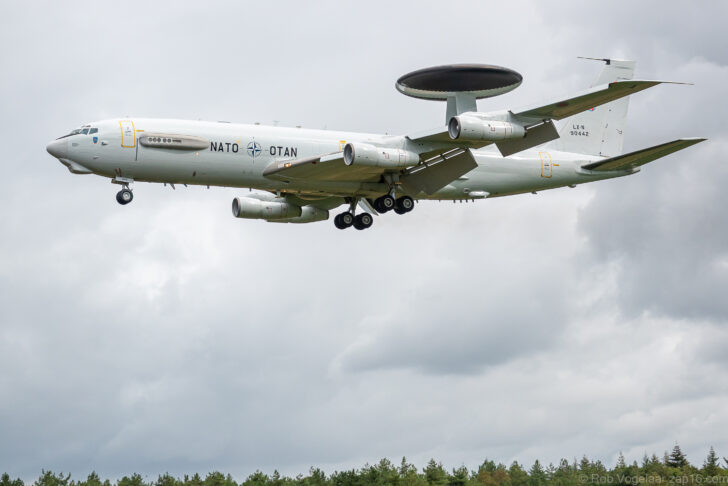
Boeing E-3 Sentry AWACS: Comprehensive Aircraft Fact Sheet
Introduction
The Boeing E-3 Sentry is an airborne early warning and control (AEW&C) aircraft that provides all-weather surveillance, command, control, and communications for military air operations. Derived from the Boeing 707 commercial airframe, this high-altitude platform detects enemy aircraft, tracks surface vessels, and directs friendly fighter jets across vast operational theaters.
General Information
-
Type: Airborne Early Warning and Control (AEW&C) aircraft
-
Manufacturer: Boeing Defense, Space & Security
-
First Flight: February 9, 1972 (EC-137D prototype) / May 25, 1976 (E-3 production model)
-
Status: In service
-
Primary Users: United States Air Force, NATO, Royal Saudi Air Force, French Air and Space Force, Chilean Air Force
-
Number Built: 68

History
In 1963, the United States Air Force initiated a program to replace its aging Lockheed EC-121 Warning Star radar fleet. Following competitive evaluations, the military selected Boeing in July 1970 to develop an airframe based on a modified Boeing 707-320B Advanced commercial jet. A parallel evaluation chose Westinghouse Electric to supply the primary rotating radar system. The prototype EC-137D completed its maiden flight on February 9, 1972, and the United States Air Force introduced the production E-3 Sentry into operational service in March 1977.
Design
The Boeing E-3 Sentry integrates a modified four-engine airframe with a distinctive rotating radar dome mounted 3.3 meters above the rear fuselage. This 9.1-meter-diameter rotodome houses an AN/APY-1 or AN/APY-2 passive electronically scanned array radar that turns at six revolutions per minute during operation. Engine-mounted electrical generators deliver up to one megawatt of power to run onboard computer processing, tactical data links, and operator displays. Depending on the variant, four Pratt & Whitney TF33-PW-100A or CFM International CFM56-2 turbofan engines power the aircraft.

Operational Impact
The Boeing E-3 Sentry fundamentally transformed aerial warfare by providing joint forces with a real-time situational awareness picture over land and sea. During major military engagements, including Operation Desert Storm, the platform directed combat air patrols, coordinated air-to-air refueling, and protected friendly strike packages from hostile interception. Its long-range radar detection enables commanders to manage complex battlespaces far beyond the range of ground-based tracking stations.
Variants
-
EC-137D: Two initial prototype testbeds created for radar fly-off evaluations.
-
E-3A: Initial production model equipped with TF33 engines and the AN/APY-1 radar system.
-
E-3B: Enhanced United States Air Force variant featuring upgraded computers, digital communications, and JTIDS data links.
-
E-3C: Production standard equipped with the advanced AN/APY-2 radar and additional mission operator consoles.
-
E-3D Sentry AEW.1: Custom build for the Royal Air Force featuring CFM56 engines and specialized British avionics.
-
E-3F: Customized variant operated by the French Air and Space Force using CFM56-2 engines and tailored software.
-
E-3G: Modernized United States Air Force Block 40/45 upgrade incorporating open-architecture computer networks.
Operators
-
Current Operators: United States Air Force, NATO, Royal Saudi Air Force, French Air and Space Force, Chilean Air Force.
-
Former Operators: Royal Air Force (phased out active operations).
-
Future Operators: None (production concluded in 1992; current operators plan transitions to next-generation AEW&C platforms).

Specifications
General Characteristics
-
Crew: 4 flight crew (commander, pilot, navigator, flight engineer) and 13 to 19 mission specialists
-
Length: 46.61 meters
-
Wingspan: 44.42 meters
-
Height: 12.60 meters
-
Wing Area: 283.4 square meters
-
Empty Weight: 73,480 kilograms
-
Gross Weight: 156,036 kilograms
-
Maximum Takeoff Weight (MTOW): 157,397 kilograms
-
Powerplant: 4 × Pratt & Whitney TF33-PW-100A turbofans (96 kN thrust each) or 4 × CFM International CFM56-2A3 turbofans (107 kN thrust each)
Performance
-
Maximum Speed: 855 kilometers per hour (Mach 0.78)
-
Cruise Speed: 580 kilometers per hour
-
Range: 7,400 kilometers (unrefueled for TF33 variants; over 9,250 kilometers for CFM56 variants; extended via aerial refueling)
-
Service Ceiling: 12,500 meters
-
Endurance: 8 to 11 hours (unrefueled)
Armament
-
Weapons: None (equipped exclusively with passive and active electronic countermeasure systems)
The Boeing E-3 Sentry remains an essential airborne command and control platform after nearly five decades of military service. Continuous avionics and mission software upgrades have preserved its combat relevance in multi-domain operational environments. As NATO and partner defense forces prepare to field next-generation AEW&C assets, the E-3 Sentry continues providing critical situational awareness across global battlefields.