Complete Aircraft Fact Sheet and Technical Overview
The Boeing 747-8 is the final, largest, and most technologically advanced generation of the iconic four-engine wide-body airliner family. Incorporating raked wingtips, a stretched fuselage, and General Electric GEnx engines derived from the 787 Dreamliner program, the aircraft entered commercial cargo service in 2011 and passenger service in 2012.
General Information
- Type: Wide-body commercial airliner, cargo freighter, and VIP/government transport
- Manufacturer: Boeing Commercial Airplanes (United States)
- First Flight: February 8, 2010 (747-8F) / March 20, 2011 (747-8I)
- Status: Active (in commercial cargo, passenger, and government service; production ended in 2023)
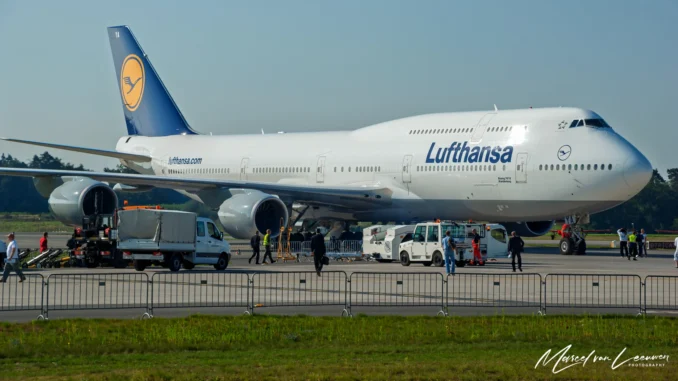
- Primary Users: UPS Airlines, Atlas Air, Cargolux, Cathay Pacific Cargo, Lufthansa, Korean Air, Air China, Nippon Cargo Airlines, Silk Way West Airlines, United States Air Force (VC-25B / interim VIP)
- Number Built: 155 (107 freighters and 48 passenger/VIP airframes)
History
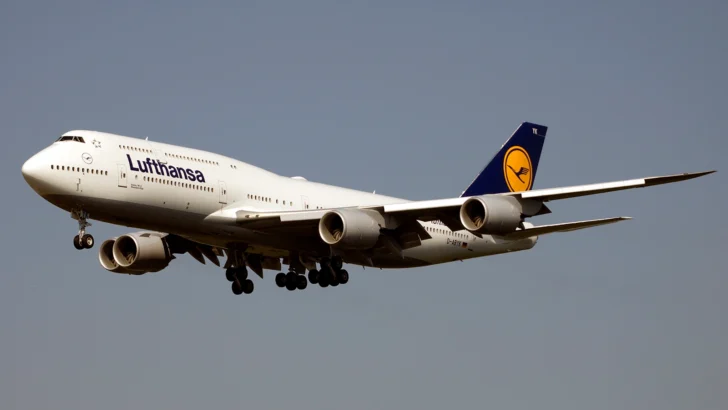
In the early 2000s, Boeing explored several stretched and upgraded derivatives—such as the 747X and 747 Advanced—to compete with the Airbus A380 and modernize the aging 747-400. Boeing formally launched the Boeing 747-8 program on November 14, 2005, securing launch orders for the freighter variant from Cargolux and Nippon Cargo Airlines. Lufthansa became the launch customer for the passenger 747-8 Intercontinental in December 2006.
Following assembly at the Everett, Washington factory, the prototype 747-8F completed its maiden flight on February 8, 2010, and the passenger 747-8I first flew on March 20, 2011. Cargolux took delivery of the first production freighter on October 12, 2011, while Lufthansa inaugurated commercial passenger operations on June 1, 2012. Production concluded on January 31, 2023, when Boeing delivered the final 747-8F (line number 1,574) to Atlas Air, closing more than five decades of 747 manufacturing.
Design
The Boeing 747-8 combined the recognizable upper-deck silhouette of the 747 with major aerodynamic, structural, and propulsion upgrades borrowed from the Boeing 787 Dreamliner:
- Stretched Fuselage: Engineers lengthened the fuselage by 5.6 meters compared to the 747-400 using plugs ahead of and behind the wing, making the 747-8 the longest volume-production passenger airliner ever built at 76.25 meters.
- Supercritical Wing and Raked Wingtips: A completely redesigned supercritical wing replaced the 747-400’s canted winglets with raked wingtips, increasing wingspan to 68.40 meters and integrating fly-by-wire spoilers and outboard ailerons.
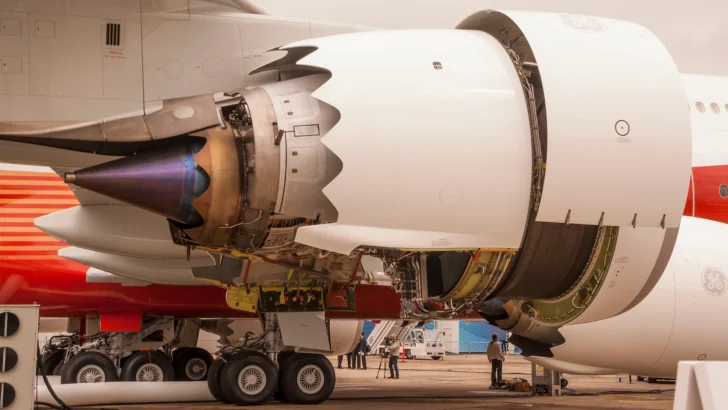
- GEnx Propulsion and Acoustic Reduction: Powered exclusively by four General Electric GEnx-2B67 turbofans featuring scalloped exhaust chevrons, the aircraft achieved significant reductions in fuel burn, carbon emissions, and community noise footprint.
- Modernized Cabin Interior: The passenger model introduced a sweeping curved staircase to the upper deck, 16 percent larger windows, sculpted overhead bins, and dynamic LED mood lighting.
Operational Impact
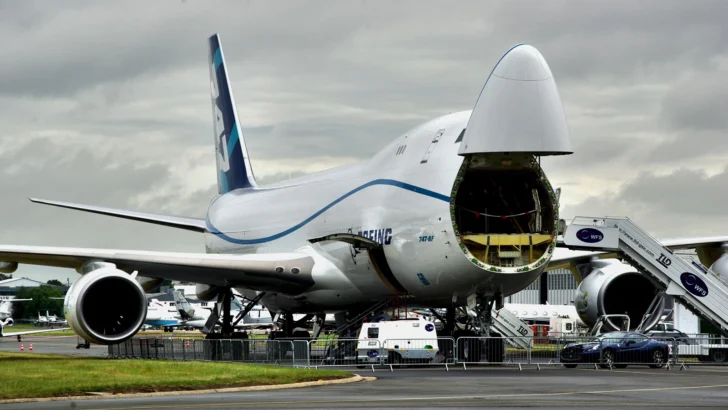
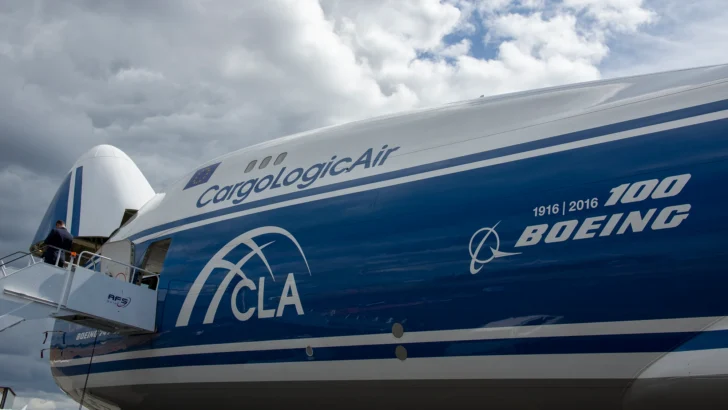
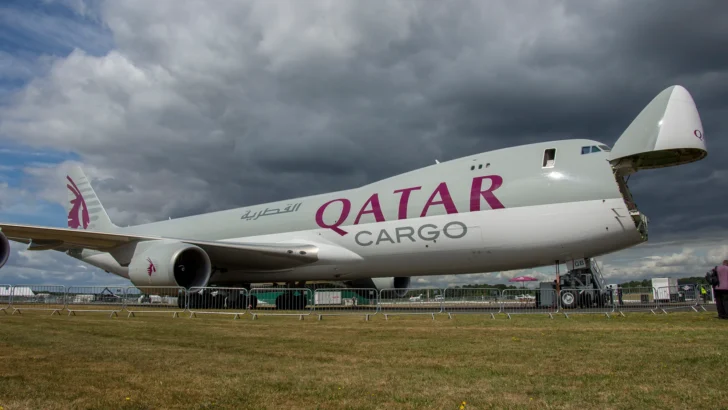
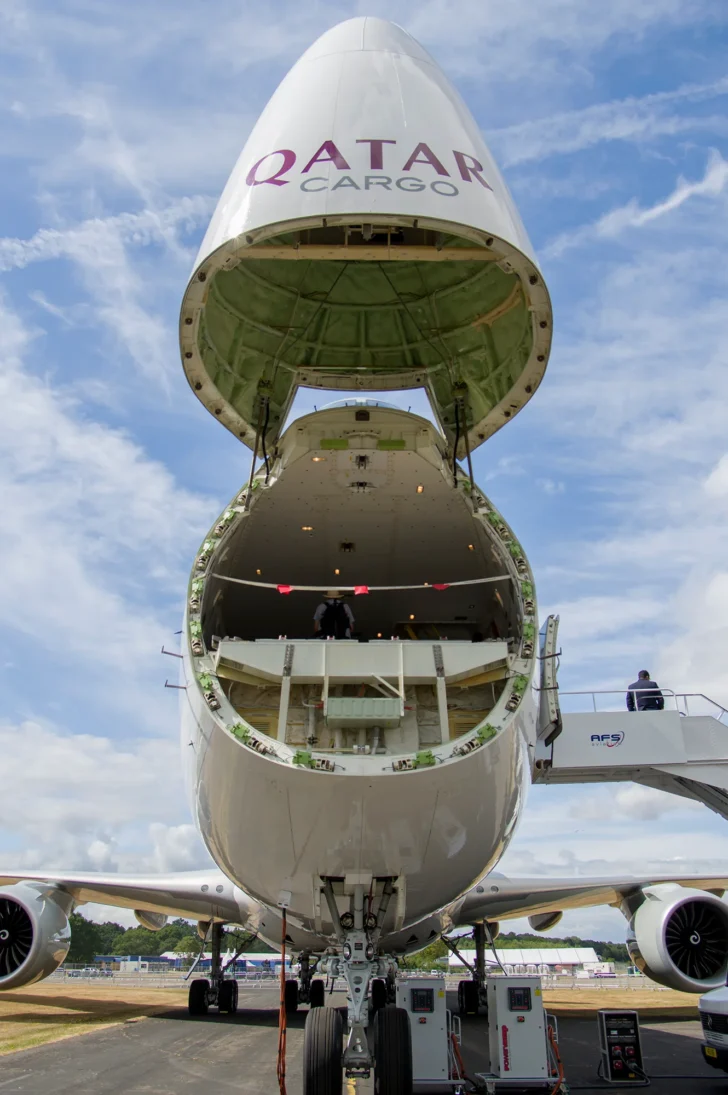
While airline demand increasingly shifted toward long-range twin-engine wide-bodies like the Boeing 777-300ER and Airbus A350, limiting passenger orders to 48 aircraft, the Boeing 747-8 made a decisive mark in global air freight. With 16 percent more cargo volume than the 747-400F, an upward-hinged nose door, and lower ton-mile operating costs, the 747-8F became the flagship heavy freighter for express integrators and international cargo carriers.
In commercial passenger service, Lufthansa, Korean Air, and Air China deployed the 747-8I on high-density intercontinental trunk routes linking Europe, Asia, and North America. Beyond commercial aviation, modified 747-8I airframes were selected to serve as the next generation of U.S. presidential transport aircraft.
Variants
- 747-8F (Freighter): The dedicated main-deck cargo variant featuring a shortened upper deck, strengthened fuselage, and upward-hinged nose cargo door (107 built).
- 747-8I (Intercontinental): The long-haul passenger and VIP transport variant featuring an extended upper deck and modernized cabin architecture (48 built).
- Boeing VC-25B: Two modified 747-8I airframes undergoing conversion for the United States Air Force to replace the aging VC-25A fleet as Air Force One.
- Survivable Airborne Operations Center (SAOC): A specialized military command-and-control derivative based on converted 747-8I airframes selected to replace the U.S. Air Force E-4B Nightwatch fleet.
Operators
Current Operators
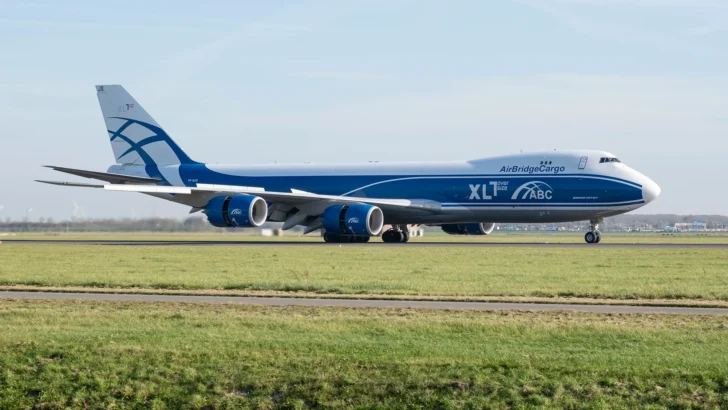
In scheduled passenger service, Lufthansa operates the largest fleet (19 aircraft), alongside Air China and Korean Air. Several VIP-configured 747-8I aircraft serve heads of state and government fleets, including the United States Air Force (operating an interim VIP transport alongside the VC-25B conversion program) and Middle Eastern royal flights. In the cargo sector, active 747-8F operators include UPS Airlines, Atlas Air, Cargolux, Cathay Pacific Cargo, Nippon Cargo Airlines, Korean Air Cargo, Silk Way West Airlines, and AirBridgeCargo (stored/inactive fleet).
Former Operators
No major commercial airlines have fully retired the Boeing 747-8 from active service, though several early VIP and private corporate airframes have transferred between government entities or entered storage.
Future Operators
With final production completed in January 2023, no new commercial airline deliveries will occur. Future operational entry is centered on the United States Air Force, which will induct the VC-25B presidential fleet and SAOC airborne command-post conversions.
Specifications
General Characteristics
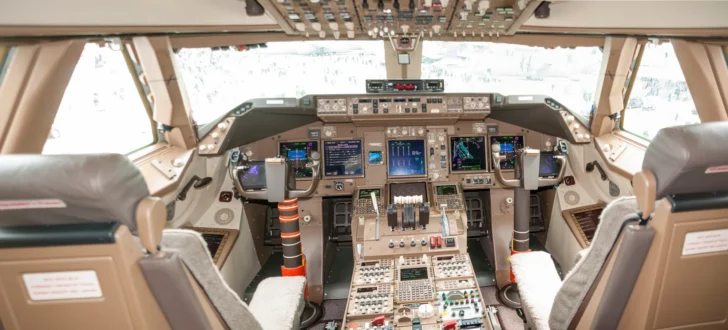
- Crew: 2 cockpit crew (Captain and First Officer)
- Length: 76.25 m
- Wingspan: 68.40 m
- Height: 19.40 m
- Wing Area: 554 m²
- Empty Weight: 220,128 kg (747-8I) / 197,131 kg (747-8F)
- Maximum Takeoff Weight (MTOW): 447,696 kg
- Maximum Landing Weight: 312,072 kg (747-8I) / 346,091 kg (747-8F)
- Maximum Structural Payload: 76,067 kg (747-8I) / 137,756 kg (747-8F)
- Maximum Fuel Capacity: 238,609 liters (747-8I) / 226,118 liters (747-8F)
- Powerplant: 4 × General Electric GEnx-2B67 high-bypass turbofans (296 kN thrust each)
Performance
- Maximum Speed: Mach 0.92 (988 km/h at cruise altitude)
- Typical Cruise Speed: Mach 0.855 (907 km/h to 917 km/h)
- Maximum Range: 14,320 km to 14,430 km (747-8I with 467 passengers) / 8,130 km (747-8F at maximum payload)
- Service Ceiling: 13,100 m
- Takeoff Field Length (at MTOW): 3,190 m
- Landing Distance: 2,680 m
Passenger Layout
- Typical 3-Class Configuration: 467 passengers (24 First Class, 87 Business Class, 356 Economy Class)
- Typical Airline 4-Class Configuration (Lufthansa): 364 passengers (8 First Class, 80 Business Class, 32 Premium Economy, 244 Economy Class)
- Maximum Certified Exit Limit: 605 passengers
- Cabin Width: 6.10 m (main deck)
The Boeing 747-8 brought the half-century production run of the Queen of the Skies to a technologically advanced close. By pairing a stretched fuselage and redesigned supercritical wing with fuel-efficient GEnx engines, the aircraft delivered unmatched capability in heavy intercontinental air freight alongside long-range passenger comfort. Although commercial production ended in 2023, the Boeing 747-8 will remain a vital fixture in global cargo networks, flagship passenger fleets, and U.S. presidential aviation for decades to come.