Introduction
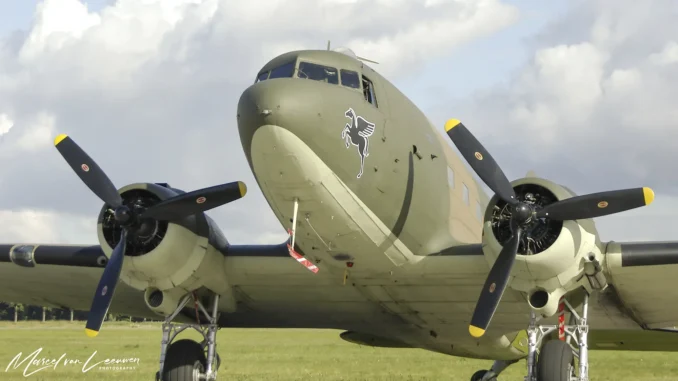
The Douglas C-47 Dakota served as the backbone of Allied aerial logistics during the Second World War. Adapted from the commercial Douglas DC-3 airliner, this twin-engine transport aircraft provided dependable tactical mobility, troop deployment, and cargo supply across every operational theater, establishing a lasting standard for modern military air transport.
General Information
- Type: Military transport aircraft
- Manufacturer: Douglas Aircraft Company
- First Flight: 23 December 1941 (military C-47 prototype)
- Status: In limited operational service (active turboprop conversions and historic preservation flights)
- Primary Users: United States Army Air Forces, Royal Air Force, Royal Canadian Air Force, Royal Australian Air Force, Soviet Air Force, French Air Force, Indian Air Force, South African Air Force, Israeli Air Force
- Number Built: 10,174 military airframes (over 16,000 including license-built Soviet Lisunov Li-2 and Japanese Showa L2D production)
History
The development of the Douglas C-47 originated in 1940 as the United States military evaluated the commercial Douglas DC-3 for mass logistics. Chief engineer Arthur E. Raymond led the Douglas engineering team in converting the civilian airliner into a rugged military workhorse. The United States Army Air Corps ordered the type under the military designation C-47 in 1940, recognizing the requirement for high-volume troop deployment and cargo resupply.
Douglas incorporated military modifications into the airframe, including a reinforced cabin floor, a heavy-duty landing gear structure, and an enlarged two-piece cargo loading door on the port side. The prototype conducted its first flight on 23 December 1941, days after the United States entered World War II. Douglas expanded mass production to dedicated facilities in Long Beach and Santa Monica, California, as well as Oklahoma City. Through the Lend-Lease policy, the aircraft entered extensive service with the British Commonwealth under the official designation Dakota.
Design
The airframe utilizes an all-metal, cantilever low-wing monoplane configuration constructed primarily of duralumin. Power comes from two Pratt & Whitney R-1830 Twin Wasp 14-cylinder radial engines driving three-bladed constant-speed propellers. Engineers fitted folding bench seats along the cabin walls to transport combat troops or paratroopers, while internal hoist fittings accommodated heavy freight, artillery pieces, and light vehicles.
Operational Impact
The aircraft delivered decisive tactical mobility across World War II, dropping airborne divisions during Operation Overlord in Normandy and Operation Market Garden in the Netherlands. In the China-Burma-India theater, aircrews flew hazardous supply missions over the Himalayas (the “Hump”). Following the war, the type sustained West Berlin during the Berlin Airlift of 1948–1949 and later saw service in Korea and Vietnam.
Variants
- C-47A: Primary production variant fitted with a 24-volt electrical system.
- C-47B: High-altitude variant equipped with two-stage supercharged engines for Himalayan airlift operations.
- Dakota Mk I–IV: British designation system applied to Lend-Lease C-47 airframes delivered to the Royal Air Force and Commonwealth forces.
- AC-47 Spooky: Forward-firing gunship conversion utilized during the Vietnam War.
- Basler BT-67: Modern remanufactured variant modified with Pratt & Whitney Canada PT6A turboprop engines and modern avionics.
Operators
- Current: Colombian Air Force, Hellenic Air Force (limited specialized roles), Basler BT-67 commercial operators, and various aerial preservation trusts.
- Former: United States Army Air Forces, United States Air Force, Royal Air Force, Royal Canadian Air Force, Royal Australian Air Force, French Air Force, Soviet Air Force, Luftwaffe, South African Air Force, Belgian Air Force, and over 90 international military services.
Specifications (C-47A)
General Characteristics
- Crew: 3 (pilot, co-pilot, navigator/radio operator)
- Capacity: 28 fully equipped troops, 14 stretchers with medical attendants, or 2,722 kg of cargo
- Length: 19.43 m
- Wingspan: 29.11 m
- Height: 5.16 m
- Wing Area: 91.70 m²
- Empty Weight: 8,226 kg
- Maximum Takeoff Weight: 11,793 kg
- Powerplant: 2 × Pratt & Whitney R-1830-92 Twin Wasp radial engines, 895 kW (1,200 hp) each
Performance
- Maximum Speed: 370 km/h at 2,600 m
- Cruising Speed: 257 km/h
- Combat Range: 2,575 km
- Ferry Range: 3,420 km
- Service Ceiling: 7,315 m
- Rate of Climb: 5.7 m/s
Armament
- Standard Transport: None
- Gunship Conversions (AC-47): 3 × 7.62 mm GAU-2/A miniguns or 10 × .30-caliber Browning machine guns mounted in the cabin windows and side cargo door
The Douglas C-47 Dakota established an unmatched benchmark for durability, field repairability, and operational utility across global military aviation. Its robust airframe survived severe operational environments, proving essential to Allied logistics throughout mid-twentieth-century warfare. Remanufactured turboprop variants continue flying specialized civilian and governmental missions globally, ensuring the airframe design maintains active flight operations deep into the twenty-first century.