Airbus A350 Fact Sheet: Specifications, Variants, and Overview
Introduction
The Airbus A350 represents a modern generation of long-range, wide-body commercial airliners. Engineed with composite materials and powered by advanced Rolls-Royce Trent XWB turbofans, the twin-engine jet delivers maximum fuel efficiency, extended range capabilities, and reduced carbon emissions for global international route networks.
General Information
- Type: Long-range wide-body commercial passenger jet
- Manufacturer: Airbus
- First Flight: 14 June 2013
- Status: In service
- Primary Users: Singapore Airlines, Qatar Airways, Cathay Pacific, Air France, Delta Air Lines
- Number Built: 734 (as of August 2026)

History
Development of the Airbus A350 began as a response to competing long-haul aircraft like the Boeing 787 Dreamliner. While initial proposals relied on modifications to the existing Airbus A330 frame, feedback from major flight operators prompted Airbus to pivot to an entirely clean-sheet design designated as the Extra Wide Body (Airbus A350 XWB) in 2006.
The program involved international design and manufacturing supply chains, with final assembly taking place in Toulouse, France. Following years of aerodynamic engineering and flight testing, the aircraft made its maiden flight in June 2013 and entered commercial revenue service with launch customer Qatar Airways in January 2015.
Design
The airframe structure integrates over 70% advanced materials, combining 53% carbon-fiber-reinforced polymer (CFRP) with titanium and lightweight aluminum-lithium alloys. This structural weight reduction lowers maintenance costs and mitigates corrosion risks.
Aerodynamically, the Airbus A350 features high-aspect-ratio composite wings inspired by bird flight dynamics, complete with curved winglets that adjust dynamically during flight to minimize aerodynamic drag. Dual Rolls-Royce Trent XWB high-bypass turbofan engines provide low noise profiles and fuel burn reductions up to 25% compared to previous wide-body generations.
Inside the cabin, the extra-wide interior accommodates higher humidity levels and a lower effective cabin altitude pressure of 1,829 meters (6,000 feet), which significantly reduces passenger jet lag and fatigue.
Operational Impact
The operational efficiency of the Airbus A350 allows airlines to open direct ultra-long-haul routes that were previously economically unfeasible. Its lower fuel consumption lowers operational costs and assists airlines in meeting corporate sustainability targets. High commonality across the Airbus family allows pilots to operate both the Airbus A330 and Airbus A350 under a single fleet type rating.
Variants
- Airbus A350-900: The baseline variant, optimizing passenger payload and extended range.
- Airbus A350-900ULR: Ultra Long Range variant configured with modified fuel systems to perform direct flights up to 18,000 kilometers.
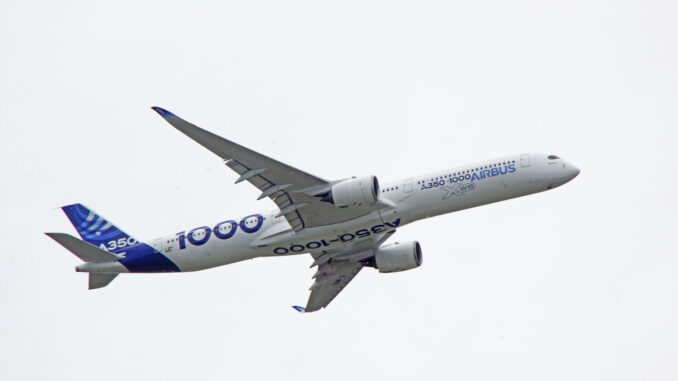
- Airbus A350-1000: A lengthened fuselage variant offering higher passenger capacity and modified six-wheel main landing gear units.
- Airbus A350F: Dedicated freighter variant engineered for heavy cargo payload transport.

Operators
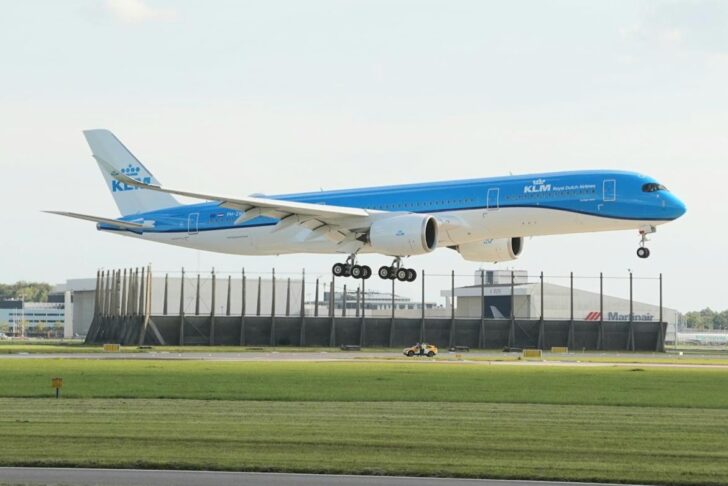
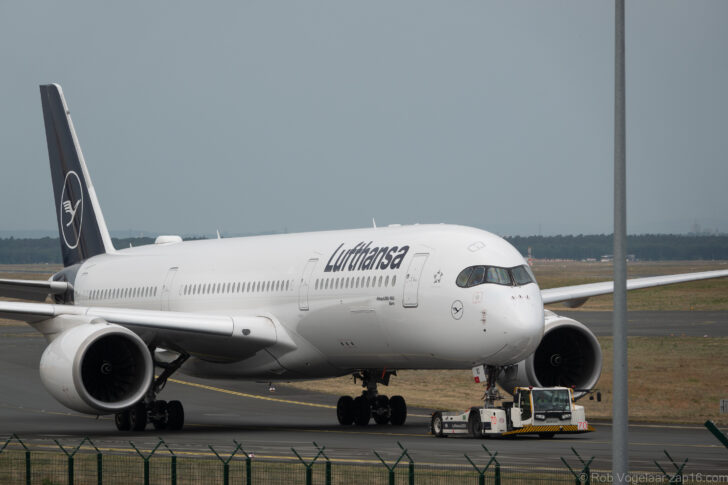
- Current Operators: Singapore Airlines, Qatar Airways, Cathay Pacific, Air France, Delta Air Lines, Lufthansa, British Airways, Japan Airlines
- Former Operators: TAM Linhas Aéreas (Latam Brasil)
- Future Operators: Qantas, Air India, Turkish Airlines, Korean Air
Specifications
General Characteristics
- Length: 66.8 meters (Airbus A350-900) / 73.79 meters (Airbus A350-1000)
- Wingspan: 64.75 meters
- Height: 17.05 meters
- Wing Area: 442 square meters
- Empty Weight: 115,700 kilograms (Airbus A350-900)
- Maximum Takeoff Weight (MTOW): 283,000 kilograms (Airbus A350-900) / 322,000 kilograms (Airbus A350-1000)
- Fuel Capacity: 141,000 liters (Airbus A350-900) / 159,000 liters (Airbus A350-1000)
- Powerplant: 2 × Rolls-Royce Trent XWB turbofans
Performance
- Maximum Speed: Mach 0.89 (approx. 945 km/h)
- Cruising Speed: Mach 0.85 (approx. 903 km/h)
- Maximum Operating Range: 15,370 kilometers (Airbus A350-900) / 16,100 kilometers (Airbus A350-1000)
- Service Ceiling: 13,100 meters
Passenger Layout
- Typical 3-Class Seating: 300 to 350 passengers (Airbus A350-900) / 350 to 410 passengers (Airbus A350-1000)
- High-Density Maximum Seating: 440 passengers (Airbus A350-900) / 480 passengers (Airbus A350-1000)
- Cabin Configuration: 9-abreast standard economy (3-3-3 arrangement) or select 10-abreast options
The Airbus A350 has established itself as a premier long-haul airliner through composite engineering, fuel efficiency, and long-range flight performance. Commercial airlines continue replacing legacy multi-engine widebody aircraft with Airbus A350 variants to streamline operations and lower carbon emissions. As fleet deliveries expand globally, the aircraft will remain a cornerstone of international long-haul aviation for decades.