Specifications, History, and Design Fact Sheet
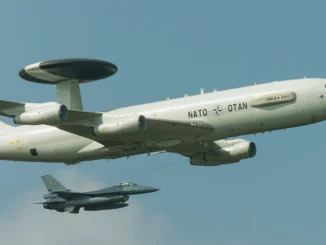
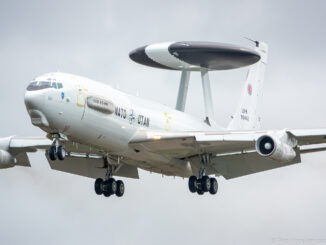
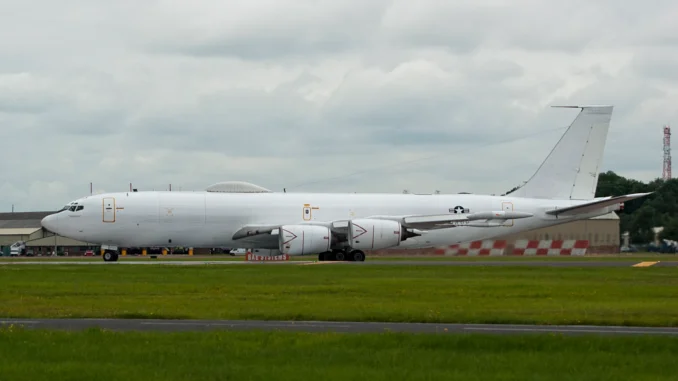
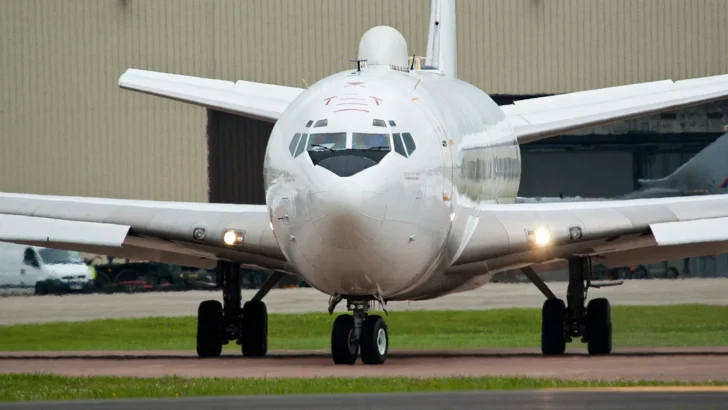
The Boeing E-3 Sentry is a four-engine Airborne Warning and Control System (AWACS) aircraft derived from the Boeing 707-320B airliner, providing all-weather surveillance, command, control, and communications for the United States Air Force, NATO, and allied air forces.
General Information
- Type: Airborne Warning and Control System (AWACS)
- Manufacturer: Boeing Defense, Space & Security (radar systems by Northrop Grumman, formerly Westinghouse)
- First flight: 25 May 1976 (production E-3A; EC-137D radar testbed first flew on 9 February 1972)
- Status: In service
- Primary users: United States Air Force, NATO, French Air and Space Force, Royal Saudi Air Force, Chilean Air Force, Royal Air Force (former)
- Number built: 68
History
The Boeing E-3 Sentry originated in the mid-1960s when the United States Air Force (USAF) launched the Overland Radar Technology (ORT) program to replace the aging piston-powered Lockheed EC-121 Warning Star. Early airborne radar systems struggled to separate low-flying aircraft from ground clutter over land. In July 1970, the USAF selected Boeing as prime contractor to construct two prototype EC-137D testbeds based on the Boeing 707-320B airframe.
Competitive fly-off evaluations between pulse-Doppler radars from Hughes Aircraft and Westinghouse Electric Corporation began in 1972. The USAF selected the Westinghouse AN/APY-1 look-down radar system, and full-scale engineering development of the E-3A Sentry followed in January 1973.
The first production E-3A completed its maiden flight on 25 May 1976, and operational deliveries began in March 1977 to the 552nd Airborne Warning and Control Wing at Tinker Air Force Base, Oklahoma. Production continued until 1992, yielding 68 aircraft across USAF, NATO, British, French, and Saudi fleets.
Design
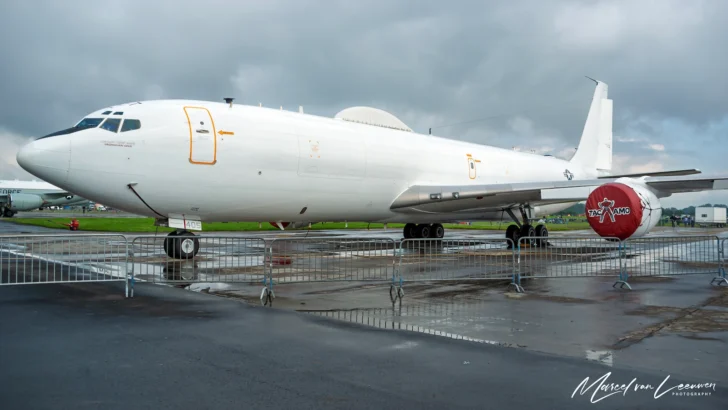
The Boeing E-3 Sentry pairs a modified Boeing 707-320B Advanced commercial airframe with a distinctive rotating rotodome mounted 3.35 m above the rear fuselage on two struts. Measuring 9.1 m in diameter and 1.8 m thick, the fiberglass rotodome completes one full rotation every 10 seconds (6 rpm) during active surveillance operations, providing 360-degree radar coverage out to more than 400 km for low-flying targets and over 650 km for high-altitude aircraft.
Inside the main cabin, mission specialists operate multi-function situation display consoles linked to high-speed data processors, Identification Friend or Foe (IFF) interrogators, and secure Link 16 tactical data links. While early USAF and NATO aircraft used Pratt & Whitney TF33-PW-100A turbofans, later export variants for the United Kingdom, France, and Saudi Arabia adopted quieter, more fuel-efficient CFM International CFM56-2A high-bypass turbofans and aerial refueling probes alongside standard boom receptacles.
Operational Impact
The Boeing E-3 Sentry transformed modern air warfare by shifting battlefield airspace management from vulnerable ground-based radar stations to a mobile, survivable airborne command post. Capable of tracking hundreds of airborne and maritime targets simultaneously while directing friendly fighters, tankers, and strike packages, the E-3 proved decisive during Operation Desert Storm (1991), where Sentry crews controlled more than 120,000 coalition sorties and assisted in nearly all air-to-air engagements.
Beyond combat operations over Iraq, the Balkans, Afghanistan, and Libya, the E-3 has served continuously in NATO eastern flank air policing, homeland air defense, and international counter-narcotics surveillance. Its architecture established the global benchmark for modern airborne battle management platforms.
Variants
- EC-137D: Two prototype radar evaluation aircraft converted from Boeing 707-320B airframes; later upgraded to production E-3A standard.
- E-3A: Initial production model powered by four Pratt & Whitney TF33-PW-100A turbofans and fitted with the AN/APY-1 radar (24 built for USAF, 18 for NATO, and 5 for Saudi Arabia).
- E-3B: Upgraded USAF E-3A airframes incorporating Block 20/25 modifications, AN/APY-2 radar, anti-jamming communications, and expanded computer memory (24 converted).
- E-3C: Upgraded USAF E-3A airframes featuring Block 30/35 enhancements, five additional operator consoles, and passive electronic support measures (10 converted).
- E-3D (Sentry AEW.1): Specialized variant built for the Royal Air Force, powered by CFM56-2A-2 turbofans and equipped with wingtip ESM pods and a British-style aerial refueling probe (7 built; 3 later sold to Chile).
- E-3F: Variant built for the French Air and Space Force, utilizing CFM56-2A-2 engines and mission systems similar to the E-3D without wingtip pods (4 built).
- E-3G: Major USAF modernization standard (Block 40/45) replacing legacy mainframes with open-architecture computing, upgraded human-machine interfaces, and enhanced multi-sensor integration.
- KE-3A: Non-radar aerial refueling tanker derivative built for the Royal Saudi Air Force using the CFM56-powered E-3 airframe (8 built).
Operators
- Current: United States Air Force, NATO (NATO Airborne Early Warning & Control Force based in Geilenkirchen, Germany), French Air and Space Force, Royal Saudi Air Force, and Chilean Air Force (operating former Royal Air Force E-3D aircraft).
- Former: Royal Air Force (retired in 2021 ahead of transitioning to the Boeing E-7 Wedgetail).
- Future: None (existing fleets are scheduled for gradual replacement by the Boeing E-7 Wedgetail and Saab GlobalEye in the late 2020s and 2030s).
Specifications (Boeing E-3G Sentry)
General Characteristics
- Crew: 4 flight crew (aircraft commander, pilot, navigator, flight engineer) plus 13 to 19 mission specialists
- Length: 46.61 m
- Wingspan: 44.42 m
- Height: 12.73 m
- Wing area: 283.4 m²
- Empty weight: 73,480 kg (83,915 kg operating empty weight)
- Maximum takeoff weight: 157,397 kg
- Rotodome dimensions: 9.1 m diameter × 1.8 m thickness
- Powerplant: 4 × Pratt & Whitney TF33-PW-100A turbofan engines, 93 kN thrust each (or 4 × CFM International CFM56-2A-2 turbofans, 107 kN thrust each on E-3D/F/Saudi variants)
Performance
- Maximum speed: 855 km/h (Mach 0.83)
- Cruise speed: 580 km/h (optimum radar station-keeping speed)
- Range: 7,400 km (unrefueled)
- Endurance: Over 8 hours unrefueled (extendable via aerial refueling)
- Service ceiling: 12,500 m (minimum operational patrol altitude 8,840 m)
Armament
- None (unarmed airborne surveillance, command, and control platform)
The Boeing E-3 Sentry has served as the cornerstone of Western airborne early warning and battle management for nearly five decades. By integrating long-range look-down pulse-Doppler radar with real-time tactical communications, it gave air commanders unprecedented situational awareness over complex battlefields. As airframes reach the end of their structural service lives, the Boeing E-7 Wedgetail is set to succeed the Sentry across the United States Air Force, NATO, and allied fleets.