Introduction
Boeing RC-135W Rivet Joint: Airborne Signals Intelligence and Electronic Surveillance Platform
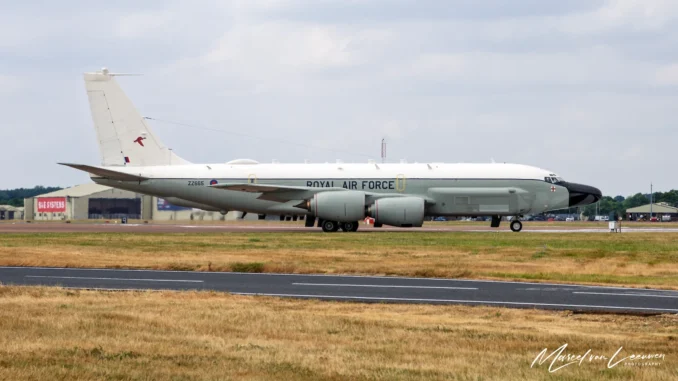
The Boeing RC-135W Rivet Joint is a specialized reconnaissance aircraft operated by the United States Air Force and the Royal Air Force. Built on a heavily modified Boeing C-135 Stratolifter airframe, the aircraft detects, identifies, and geolocates electromagnetic signals in near real time to support theater commanders and national intelligence agencies worldwide.
General Information
| Attribute | Details |
| Type | Electronic reconnaissance / Signals Intelligence (SIGINT) aircraft |
| Manufacturer | Boeing (airframe), L3Harris Technologies (mission systems integration) |
| First Flight | 1961 (base RC-135 airframe); 1972 (Rivet Joint configuration) |
| Status | Active service |
| Primary Users | United States Air Force (USAF), Royal Air Force (RAF) |
| Number Built | 32 total RC-135 airframes produced across all variants (converted from existing C-135/KC-135 stock) |
History
The RC-135 lineage began in the early 1960s when Strategic Air Command required long-range airborne platforms to monitor Soviet ballistic missile tests and electronic emissions. The United States Air Force selected Boeing to adapt its C-135 Stratolifter transport and KC-135 Stratotanker designs under the classified Big Safari acquisition program. Initial reconnaissance conversions entered service in January 1964.
During the Vietnam War and the later decades of the Cold War, early reconnaissance models such as the RC-135C Big Team and RC-135M Rivet Card underwent continuous sensor and airframe upgrades. By the late 1970s and early 1980s, surviving RC-135M airframes and converted C-135B transports were standardized into the RC-135V and RC-135W Rivet Joint configurations. In 2010, the United Kingdom selected the RC-135W under Project Airseeker to replace its retiring Nimrod R1 fleet, acquiring three converted KC-135R airframes that entered RAF service between 2013 and 2017.
Design
The Boeing RC-135W Rivet Joint retains the swept-wing, four-engine layout of the Boeing C-135 Stratolifter while incorporating extensive structural modifications for electronic surveillance. Externally, the aircraft features an elongated nose radome, large side fuselage cheek fairings housing sensor arrays, and multiple blade antennas mounted along the upper and lower fuselage. An aerial refueling receptacle mounted above the forward cockpit allows the aircraft to extend mission endurance.
In 2005, the fleet completed a major propulsion and avionics modernization program. Contractors replaced the original Pratt & Whitney TF33 turbofans with four high-bypass CFM International F108-CF-201 engines and upgraded the flight deck to a digital glass cockpit. Inside the cabin, mission workstations accommodate electronic warfare officers, intelligence operators, and airborne maintenance technicians who process intercepted communications and radar emissions on board.
Operational Impact
The RC-135W Rivet Joint has participated in every major military conflict and contingency involving the United States and its allies since the Cold War. Operating from stand-off orbits in international airspace, the aircraft maps adversary air defense networks, tracks troop movements, and distributes real-time threat warnings to friendly air and ground forces.
Notable deployments include operations in Southeast Asia during the Vietnam War, Operation El Dorado Canyon over Libya, Operation Desert Storm, Balkan peacekeeping missions, and operations in Iraq and Afghanistan. In the 2020s, both USAF and RAF RC-135W aircraft have maintained regular intelligence-gathering patrols over Eastern Europe, the Black Sea, and the Indo-Pacific region.
Variants
- RC-135V Rivet Joint: Earlier Rivet Joint standard converted primarily from RC-135C airframes; now shares virtually identical mission systems and engines with the RC-135W.
- RC-135W Rivet Joint: Standard signals intelligence configuration converted from RC-135M, C-135B, and KC-135R airframes.
- RC-135W Airseeker: Royal Air Force designation for its three RC-135W aircraft operated in full interoperability with the USAF fleet.
- TC-135W: Unarmed flight-crew training variant equipped with reduced antenna suites to prepare Rivet Joint pilots and navigators.
- RC-135S Cobra Ball: Related specialized variant equipped with electro-optical sensors to track ballistic missile flights.
- RC-135U Combat Sent: Related variant configured for technical intelligence collection on foreign radar emitters.
Operators
Current Operators
- United States: United States Air Force – Air Combat Command, 55th Wing (based at Offutt Air Force Base, Nebraska, with forward operating locations worldwide).
- United Kingdom: Royal Air Force – No. 51 Squadron (based at RAF Waddington, Lincolnshire).
Former Operators
- None. Only the United States and the United Kingdom have operated the RC-135W.
Future Operators
- None announced. Both the USAF and RAF have committed to joint modernization and sustainment of the existing fleet through at least 2035.
Specifications
General Characteristics
- Crew: 4 to 5 flight crew (pilots and navigators) plus 21 to 27 mission crew (electronic warfare officers, intelligence operators, and maintenance technicians)
- Length: 41.1 m
- Wingspan: 39.9 m
- Height: 12.8 m
- Wing Area: 226 m²
- Empty Weight: 78,743 kg
- Max Takeoff Weight: 133,633 kg
- Fuel Capacity: 58,967 kg
- Powerplant: 4 × CFM International F108-CF-201 high-bypass turbofan engines, 96 kN thrust each
Performance
- Maximum Speed: 933 km/h
- Cruise Speed: 870 km/h (Mach 0.66)
- Range: 6,500 km (unrefueled; extendable via aerial refueling)
- Service Ceiling: 15,240 m
- Rate of Climb: 24.9 m/s
Armament
- Guns / Missiles / Bombs: None. The RC-135W is an unarmed reconnaissance platform dedicated entirely to passive electronic surveillance and communications interception.
The Boeing RC-135W Rivet Joint remains a cornerstone of Western airborne intelligence, surveillance, and reconnaissance (ISR). Through continuous Big Safari spiral upgrades, modernized engines, and seamless interoperability between the United States Air Force and the Royal Air Force, the six-decade-old airframe design continues to deliver vital real-time electronic battlefield awareness. Joint bilateral support agreements ensure the fleet will remain operational well into the 2030s and 2040s as next-generation sensor suites are integrated.