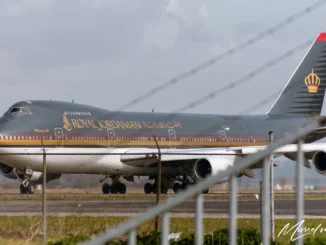
Ultra-Long-Range Wide-Body Jet Airliner
The Boeing 747SP (“Special Performance”) is a shortened, ultra-long-range derivative of the Boeing 747 wide-body jet airliner developed by Boeing Commercial Airplanes. By removing fuselage sections forward and aft of the wing while retaining full fuel capacity, Boeing created the longest-range commercial airliner of its era, capable of flying non-stop across intercontinental routes.
General Information
- Type: Ultra-long-range wide-body commercial jet airliner
- Manufacturer: Boeing Commercial Airplanes (United States)
- First Flight: July 4, 1975
- Status: Retired from commercial airline service; active in limited engine-testbed service
- Primary Users: Pan Am, Iran Air, South African Airways, United Airlines, Qantas, Syrian Air, Korean Air, China Airlines, CAAC, Pratt & Whitney Canada
- Number Built: 45
History
In the early 1970s, Pan American World Airways (Pan Am) and Iran Air jointly approached Boeing for a high-capacity airliner capable of flying non-stop between New York and Tehran, the longest commercial route in the world at the time. Simultaneously, Boeing sought a smaller wide-body aircraft to compete against three-engine wide-body jets like the McDonnell Douglas DC-10 and Lockheed L-1011 TriStar.
Boeing officially launched the Boeing 747SP program following Pan Am’s initial order in 1973. Rather than designing an all-new wing, Boeing engineers shortened the standard Boeing 747-100 fuselage by 14.35 meters, reducing structural weight and aerodynamic drag. The prototype completed its maiden flight on July 4, 1975, earned Federal Aviation Administration certification on February 4, 1976, and entered commercial service with launch customer Pan Am on April 25, 1976. Production ran primarily from 1976 to 1982, with one final aircraft completed in 1987 for the Abu Dhabi Amiri Flight, bringing total production to 45 units.
Design
The Boeing 747SP is the only production variant of the 747 family to feature a shortened fuselage. Removing two fuselage plugs reduced overall length to 56.31 meters and decreased the number of main-deck passenger doors from five to four per side. Because the shorter fuselage reduced the aerodynamic moment arm of the tail, engineers fitted a taller vertical stabilizer with a double-hinged rudder and extended the horizontal tailplane span to maintain directional stability.
To further save weight, Boeing replaced the complex triple-slotted trailing-edge wing flaps of the standard 747 with simplified, lighter single-piece slotted flaps. The aircraft utilized a three-person flight deck crew and was powered by four high-bypass turbofan engines—primarily Pratt & Whitney JT9D-7, Rolls-Royce RB211-524, or General Electric CF6-45 models.
Operational Impact
The Boeing 747SP pioneered ultra-long-haul non-stop commercial aviation during the late 1970s and 1980s. It enabled carriers such as Pan Am, South African Airways, and Qantas to inaugurate non-stop flights across the Pacific, Atlantic, and Indian Oceans, eliminating time-consuming refueling stops.
The aircraft also set multiple world aviation records, including Pan Am’s 1976 round-the-world speed record (“Liberty Bell Express”) and its 1977 polar circumnavigation flight (“Pan Am Flight 50”). Beyond commercial service, several airframes were converted into VIP transports for Middle Eastern heads of state, while NASA modified one airframe into the Stratospheric Observatory for Infrared Astronomy (SOFIA) airborne telescope, which operated until September 2022.
Variants
- 747SP: The sole commercial production model, built in 45 units with a shortened fuselage, taller vertical tail, and simplified single-slotted wing flaps.
- 747SP SOFIA: A single modified 747SP (formerly operated by Pan Am and United Airlines) fitted with a 2.7-meter infrared reflecting telescope behind a sliding fuselage door for joint NASA and German Aerospace Center (DLR) astronomical missions.
- 747SP VIP / Head-of-State Transports: Standard 747SP airframes refitted with custom executive cabins for royal and government flights in the Middle East.
- 747SP Engine Testbeds: Two airframes modified by Pratt & Whitney Canada with a specialized pylon on the upper right forward fuselage to test next-generation turbofan and turboprop engines in flight.
Operators
- Current: Pratt & Whitney Canada operates two modified Boeing 747SP aircraft as flying engine testbeds. No commercial airlines or government agencies operate the type in regular service.
- Former: Historic commercial operators included Pan Am, Iran Air (which operated the final commercial passenger flight in 2016), South African Airways, United Airlines, Qantas, Syrian Air, Korean Air, China Airlines, CAAC, Braniff International, TWA, Royal Air Maroc, Aerolíneas Argentinas, and Mandarin Airlines. Government and scientific operators included NASA, the Royal Flight of Oman, Bahrain Amiri Flight, Qatar Amiri Flight, and Saudi Arabian Royal Flight.
- Future: No future orders or new operators exist; the remaining testbed airframes will eventually retire as newer test platforms take over.
Specifications
General Characteristics
- Flight Crew: 3 (Captain, First Officer, Flight Engineer)
- Length: 56.31 m
- Wingspan: 59.64 m
- Height: 20.06 m (with landing gear extended)
- Wing Area: 511 m²
- Cabin Width: 6.13 m (main deck internal width)
- Operating Empty Weight: 147,420 – 152,906 kg
- Maximum Takeoff Weight (MTOW): 299,370 – 317,515 kg
- Maximum Landing Weight: 204,117 kg
- Fuel Capacity: 190,630 L
- Powerplant: 4 × Pratt & Whitney JT9D-7A/7J, Rolls-Royce RB211-524C2, or General Electric CF6-45A2 high-bypass turbofans (206.8 – 220 kN thrust each)
Performance
- Cruise Speed: 910 – 935 km/h (Mach 0.85 – 0.88)
- Maximum Operating Speed: 975 – 1,004 km/h (Mach 0.92)
- Range: 10,800 – 12,320 km (with typical passenger payload)
- Service Ceiling: 13,700 m
- Takeoff Field Length (at MTOW): 2,820 m
- Landing Field Length (at MLW): 1,600 m
Passenger Layout
- Typical Three-Class Configuration: 230 – 276 passengers
- Typical Two-Class Configuration: 315 – 331 passengers
- High-Density One-Class Configuration: Up to 400 passengers
Although only 45 airframes were built before newer long-range jets like the Boeing 747-400 superseded its niche, the Boeing 747SP proved the commercial viability of ultra-long-haul non-stop air travel. Its shortened fuselage, higher service ceiling, and record-breaking range made it one of the most distinctive variants in the Boeing 747 lineage. With commercial and governmental passenger service concluded, only two specialized Pratt & Whitney Canada engine testbeds remain active, preserving the type’s legacy in aerospace research and development.